

Files
Download Full Text (5.9 MB)
Description
PF2.1.110
Date
7-4-1831
Transcript
Kenyon Coll: Knox Co. State of Ohio
4th July 1831
My dear Father
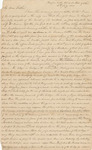
I have this morning rec’d yr letter to Mr. Dixon of the 18 April (which is the only one that has yet come to hand) & am fully sensible of the truth of its contents as far as regards myself. Mr. Dixon left this for York N.C. on the 28th May sadly disappointed and perplexed, not knowing whither to turn, the understanding between uss was that he wd write me as soon as he became settled & in the meantime I shd open any letter from you and acquaint him of the contents by post. He rec’d a letter from his Brother Joseph while here but that from Mr Soborn still likes in the office. I wrote you from York on the 10th April a scetch of my Uncle Rober’s situation and that of his family (by a storekeeper of that town who was going to England) which I hope you have since rec’d. Mr Dixon and I set out from York in the beginning of May and arrived in 8 days at Kenyon College. I shall not attempt to describe our feelings on pur arrival--but shall only say--they were none of the most agreeable-- I confess we were not prepared for such a scene-- the College in Embryo-- the centre buildings alone standing, not even a foundation laid for the wings--and the [?] [Vernon]--that “limpid stream” which we expected to see so beautifully meandering round the base of the College Hill [faded] on our approach & became contracted to a despicable rivulet. The “flourishing town of Gambier” to which Emigrants were so cordially invited proved to be a few straggling frame houses (9 in number including the store, Blacksmith’s & carpenter’s shop &c) built solely for the use of students who might not have accommodation within the narrow precincts of the college. The walls of Rosse Chapel nothing more than parapets and, in all human probability, likely to remain so--
Such was the condition we found things in, on our arrival and under stitch circumstances, as you may suppose, this place was not very prepossessing. The scenery around might probably be considered handsome but when stript of the embroidery of Mr Wests imagination, loses all its romanticity; and we, prejudiced as we were in favor of it, had to turn with disgust from this “Modern Arcadia.” I cannot conceive what cd have been Mr West’s motive in standing up in a pulpit to proclaim aloud such barefaced lies in the face of God and Man, knowing as he must have known, that his gross misrepresentation of the College & everything connected with it, were calculated to ruin those Emigrants who might become prey to his deceit and their own credulity, by entailing such hardships and expense upon them. The fact is, the Bishop never intended laying out a lot for a town in the immediate vicinity of the College for reasons religious, moral, and economical, in the first place to obviate as much as possible, the demoralizing influence of taverns and gambling houses, to which the American Youth are generally addicted, and in the next to secure to the College the Monopoly of all goods consumed in its vicinity which, if I may judge from the prices, brings in mo inconsiderable revenue, at the close of the year. The College land, as you all know, consists of 8000 acres, which are divided into two equal parts, called the north and south sections. The north section wd be sold by the Bishop to one person for £4000 to enable him to finish the College and chapel. However he wd prefer retaining it, if possible, as it wd constitute, at some future day a rich supply of timber and fuel for the College and cd not be disposed of without a sacrifice in consequence of the very low [late] at which wild land is sold by Congress. But the South Section upon which the Building stands is the unalienable property of the College and in communion with the North section is free from taxes. The soil is extremely rich and fertile and abounds with heavy timber Oak Chestnut walnut maple &c and the rich glens and bottoms along the banks of “Old Creek” which the Bishop has dignified with the name of Vernon river are, it is generally believed as good land as any in the Union. At present there is abt 1/12 of the whole in a state of cultivation and pasturage, which does not afford one half the provisions consumed by our “present family” (160 including the grammar school) If the buildings were erected so as to accommodate 500 or 600 students, which was the number originally specified, it wd take abt 2000 acres in a state of cultivation and proportionately stocked with young cattle to supply them with provisions.I suppose you are aware that the original design was to build the College in the form of the letter H allowing the connecting part of the letter to represent the centre building which lies East and West fronting the North and is 4 stories high, the Basement story being all one apartment & answering the purpose of a dining Hall. The other 3 stories (4 rooms on each floor) are occupied by the Bishop students & “Faculty” In the rear, or immediately south is the College Kitchen which together with the college is built of Sand Stone of which there is a great abundance in the North Section. The Grammar (or preparatory) school is a large frame Building for the use of those who do not belong to the Coll. classes. In it is a Schoolroom 60 feet long & forty wide: and 10 feet above this is a dormitory intended to accommodate Boys, having an upper story with windows, similar to those in the nave of a church intended for ventilation. It has 2 room for teachers one for recitation and one for washing the persons of the Boys The school room serves on Sunday for divine service & it is situated immediately opposite Rosse Chapel half way between the Coll and Gambier. There are 80 baths in the college something similar to those in the Steerage of a vessel. The rooms are little [?] than half the size of your drawing room and there are at present 3 students in each room
Recommended Citation
Hoey, William A., "Letter from William A. Hoey to his father - incomplete" (1831). 19th Century Correspondence. 39.
https://digital.kenyon.edu/correspondence_19thc/39