

Files
Download
Download Full Text (26.1 MB)
Content Warning
The Charles P. McIlvaine letters were written in the 18th and 19th century and therefore may contain language that we understand today as harmful or offensive. You may encounter paternalist descriptions of Native Americans, racial slurs, or sexism. For more information, see our policy page.
Description
Promotion of the American cause (handwritten copy)
Date
2-7-1862
Keywords
letter, McIlvaine, wife
Recommended Citation
McIlvaine, Charles Pettit, "C.P. McIlvaine to Emily (Coxe) McIlvaine" (1862). Charles Pettit McIlvaine Letters. 174.
https://digital.kenyon.edu/mcilvaine_letters/174
Rights Statement

Transcript
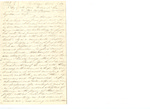
Copy of letter from Bishop M McIlvaine to Mrs. McIlvaine
Tunbridge Wells
Feb. 7 1862
My dearest wife,
How strange it seems to be so long away from you, and all the dear ones at home, and such solemn and critical interests of our Country being settled, and I so long engaged here with such persons as I have to meet and talk with about those interests. It is a remarkable chapter in my history. I almost forget that I am in England. London has become so familiar – English scenes so accustomed – that except that I am absent from you all and my diocese, I hardly realize that I am in a foreign land. Yes, but I do, when I meet with, as I do meet with them, so many with whom, as a deep dyed American, it is most annoying to meet, and talk, and see their ignorance, and half concealed superciliousness, and cold selfishness under profession of a wonderful zeal to see us proclaim instant abolition of slavery as the price of their sympathy with us. Such I do meet – not however wanting in good manners towards me, nor among such Christian brethren as I have been used to associate with here. We had a great meeting last Friday night week at Mr. Kinnaird’s to “ventilate” American affairs. Two drawing rooms were filled. I wrote an account of it to Reed and asked him to send you the letter so I will not repeat, but I carried the war unto the enemy’s country and charged horse & foot. I was up. My spirit was provoked and I administered a dose. Baptist Noel looked all delight, for he is earnestly and intelligently with us. Mr. Kinnaird cried here – here. He is most zealously with us. When it was over a clergyman, Mr. Winton, came to me and said, “I am wholly with you.” I turned to the most “fractious” of the others, a clergyman named Gemiay[?] and said, “Are you not satisfied now?” He answered, “That was just what I wanted to hear.” By and by came a note from a clergyman saying great good had been done and asking if a public meeting had not better be called that we might say such things to many more. But I decline all public meetings. Yesterday Mr. Weed told me he had heard several say they were satisfied by that meeting. Last Wednesday we went to dine and stay the night at Fulham Palace, Bp. of London’s. There were present the Bps. of Oxford, Bangor, Bath and Wells, Gloucester and Carlisle, Dean French, Sir John & Lady Wood, Mr Sullivan, brother-in-law of Lord Palmerston, his daughter etc. I had some effective talk with London and Carlisle about our matters. It was the day before Parliament. Dean French took Nain to dinner. He was as ignorant of all about our affairs asif America was not. But he kept putting questions to Nain & she, knowing how little he sympathised with our side, did not want to talk on the subject. But he would, and you should hear from her own lips how she met him. Not a bit afraid – really able to deal with him, very proper, but very decided and firm and brave. At last she put a home thought at him. “Dean French, (as if she had not any special meaning) since the English Govt. put down the Sepoy Rebellion, have they opened the public schools among the natives to the reading of the Scriptures?” “I don’t know.” She had him. In other words, you won’t sympathize with us unless we proclaim the abolition of slavery. What fruit for the liberation of the Hindoos has come of your success against their rebellion. You are afraid to introduce the Scriptures to the schools lest you offend them. “I do not know” said the harried Dean. Nain marched off with colours flying. I’m proud of my daughters. The Govt. ought to give Nain a salary. She is perfect steel here, and very intelligent in the whole matter – and draws a great deal of admiration. Anna don’t come out so much in the controversy – but holds her own bravely and gets “sasine” without showing it except to us. I must leave them to describe the dinner and company at the Duke of Argyll’s where we met another Cabinet Minister, Mr. Milnor Gibson. It seemed almost as if we were among Americans. So American was the conversation of the Duke and Duchess as indicating a cordial feeling with our side, and a very intelligent sense of our cause. For several days we have been staying at a very delightful house in one of the finest parts of London. West Southwick Crescent, Hyde Park – at the house of an old friend Mr. Bridges. Last Thursday Parliament met, Nain and Anna being engaged to meet a party at dinner, asked to meet them at Mr. Bridges – could not go to the speaking in the Ev. but were at the opening by the Lord Chancellor in the House of Lords. I heard Lord Derby, and then had to go to Buckingham Palace to meet the Prince of Wales. Through Gen. Bruce he had requested me to go there at ½ past 7. When I got to the palace what a journey it was through long halls before I came to the room in which I was to see him. There I waited a few moments surveying the surroundings till he, accompanied by the Prince, came in. He was just as cordial and open and as devoid of anything like stiffness of etiquette as when I was with him at West Point. The object of the meeting was simply that before he went on his Eastern tour he might show me as much attention as under his circumstances of sorrowing, he could. They were then just getting off in a quarter of an hour, to take a night journey to France. The Prince talked about our game of nine pins. The Gen. said they often spoke of it. I knew their time was short. I therefore said, I will not now detain you, and we bade goodbye after a short interview. But after he had gone Gen. Bruce asked me to stay longer and then he said how much the Prince had regretted that in consequence of his family he had not been able to show me more attention – that he had often spoken of it and especially after the letter I had written him – and the Gen. added for himself – “How unfortunate it is that just when you are here this state of things has occurred.” They both asked about my daughters, and I gave Nain’s and Anna’s respectul sorrow [?] which Anna said was [?]. Before I left the palace I took two cups of the Queen’s coffee and some fixins besides.The next day I dined at Lady Decies’. Nain and Anna were expected by Nain had an inflamed eye and Anna stayed with her. We had another Cabinet Minister, Sir George Gray, whom you met when you dined at Lord Shaftbury’s – also Lord Charles Russell, brother of Lord John – Sir [Cullen Eardly?] – drivers noble ladies – and laymen of position. My excellent friend, Kinnaird, led the conversation to American affairs to draw me out. The manner of Sir George Gray provoked me, or rather aroused the Stars and Stripes in me – what he said was not to me, but it fired me – and if I did not let out!! Cabinet Minister, or what else – I did not spare and he made no answer. But Lord Russell only became the more agreeable and attentive and asked how long I was to be in London & where – that he might show me some attention. Then I was asked to have prayers and expound Scriptures to the company. The next day I came here. Saturday and yesterday preached in the parish church – a very cold day and the maid would insist upon opening the door of my room every time I went out to give it air and thus I could not keep it warm. I return to London today expecting to hear of an arrival and some gerat news of our armies. Our last was the battle of Somerset in Ky. – but no details. How anxiously we all look for news. A few decisive actions would settle matters with foreign governments. We were quite anxious about the meeting of Parliament but the speeches on the side of the ministry and the opposition indicate that the Govt. will wait yet longer before they interfere in any way. But they will not wait forever. Poor Mason who is here (Slidell is in Paris) is scarcely heard of. They will do no harm & it is a pity they were ever molested in their attempt to come here.
London – We have little news, though we have the telegrams of the Arabic to Jan. 28. Letters today from dearest Mamy and her admirable husband. I am glad he has resigned and returned to Chillicothe. He has been a most faithful officer & no doubt God has blessed his labours. How interesting the presentation of the Bible by one of the companies. But I am uneasy about his throat and cough. He thinks the army in Ky. can not advance until the spring shall settle the roads – but unless something important is soon obtained the European Powers will not observe the blockade very long and our Govt. will break down under the expense. We were at the Houses of Parliament this evening. The girls went first to the Gallery of the Commons & stayed till the House rose, which they did very soon – no business being on hand. Mr. Kinnaird then took them to the Lords & placed them where you once were – while I was on the steps of the throne. They heard Lord Malmesbury, Lord Grosvenor & Earl Russell. The first asked the Minister what was the efficiency of our blockade, no doubt with a pacific view of giving Lord Russell an opportunity of saying something on that head. The brief speech of the latter was quite favourable to nonintervention. He said he had talked with Mason about the blockade – who said that about 600 ships had run it. The earl asked him what their tonnage was. The Earl said that was a very important question. Mason said he did not know. Earl R. said if the greater part of them were little coasting vessels, they did not break the blockade. There will be a strong effort made to induce the ministry to disrupt it. But Earl Russell said privately that it will not succeed. We expect letters tomorrow by the Arabic. HereI leave my letter till tomorrow only adding that as we were walking this evening in the lobby of the Houses of Parliament, we met the Duke of Newcastle who seems mighty well pleased to see us – asked if I had played nine pins lately – seemed exceedingly cordial, asked where we were in London etc. etc. Next Sunday is my day to preach in St. Paul’s. I feel a little nervous about it – such an enormous congregation – Americans seeking for tickets – clergy going etc. The Lord enable me to be as well as to do, what is right in his sight.
Wed. Feb. 12th – At Lord Rayleigh’s, Essex. Yesterday we rejoined Mr Carus, the Bp. of Rochester & [?] to come here. Carriages were waiting at the station to bring us and the other company to this place, the seat of Lord R. A large company at dinner last evening. Lady R. is a sister to Capt. Vicars & one of the gentlemen, his brother. You should see my room and the girls’ – large enough for a convention each. Just as we were leaving our lodgings came a glorious batch of letters. The battle of Somerset is of great importance. This morning there were 24 at breakfast. We went through a beautiful conservatory last evening to get to the family chapel for prayers. Lady Rayleigh is very handsome – just the face and form for a princess.
We go to Chelmsford, 6 miles, to attend a meeting of the Irish Church Missions – then a few miles to Danbury, the seat of the Bp. Rochester – thence 2 days with him to London, where my work lies so much. Oh! For a little of home, dear ones all, I wish you could see the girls in their associations. I am so amazed to see how perfectly at home Anna is everywhere & with everyone. You sent us an Intelligence, containing the first detailed account of the Somerset battle – [copy ends]