

Jews who held any lingering hope that Nazi Germany’s annexation of Austria (Anschluss) would mean that the worst manifestations of Nazism would ameliorate, that the relentless persecution and violence against Jews would abate, were in for overwhelming disillusionment as despair and panic ensued with the Kristallnacht pogrom - the “Night of Broken Glass" of November 9-10, 1938. Synagogues in Germany and Austria were targeted by arson; property and shops owned by Jews were looted and destroyed, physical violence against Jews was rampant: adults, children and infants were targeted. As many as 400 or more (some estimates range in the thousands) suicides and murders occurred. 30,000 men were deported to concentration camps.
The Jews would receive a bill for the damage that was incurred.
Approximately 150,000 Jews fled the Reich (Germany and Austria) after Kristallnacht.
The following are examples of the experience of Jewish individuals, families and groups in search of a safe harbor from the Nazi menace. For further information about help received by Jewish refugees from those who risked life and career to save Jews, see the subcollection AID AND RESCUE: RIGHTEOUS DIPLOMATS AND OTHERS.
Alexander Distler emigrated to Great Britain in 1939, fleeing Austria after Kristallnacht, soon after the first group of Kindertransport children arrived. An architect/engineer, Distler was sent to Canada out of concern that he was a possible “enemy alien” and spent the war years in several camps with other refugees. He emigrated to Great Britain after the war. His mother remained in Austria. Distler later discovered that she had been deported to Theresienstadt where she presumably perished.
See the subcollection FLIGHT AND EMIGRATION: THE ODYSSEY OF JEWISH REFUGEE ALEXANDER DISTLER FROM 1939-1955
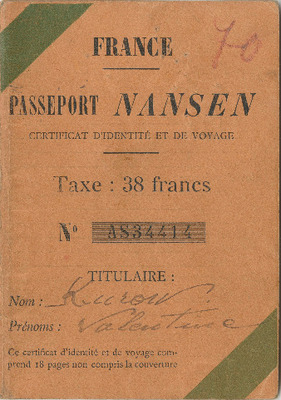
Valentine Kurow was a 34-year-old Jewish woman originally from the seaport town of Odessa in Russia. She had fled Russia with her mother just after the Revolution in 1917and the ensuing civil war, held a Brussels, Belgium work permit, and found herself in Bordeaux, France just ahead of the German invasion on May 10, 1940, a stateless immigrant along with thousands of Jews fleeing south attempting to escape the advancing Nazi juggernaut. On June 5, 1940, diplomat Aristides de Sousa Mendes, the Consul General in the Portuguese Legation in France, signed a Portuguese visa for her, and Valentine was able to cross into Portugal and sail from Lisbon to the United States on the Exeter onJuly18, 1940.
See 2023.1.10 for more about her compelling story.
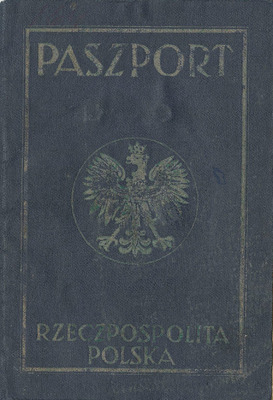
Joseph Heidenstein survived the deportation by the Nazisknown as the Polenaktion living in a makeshift camp on the Polish border. He eventually traveled to London in 1940, having secured visas to Belgium and Holland.
See 2022.1.59
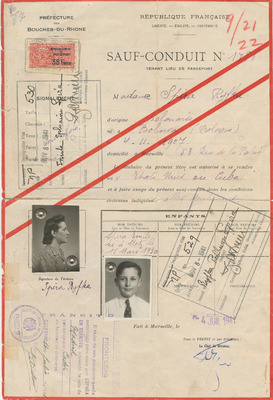
Ryfka and Emile Spira, a Jewish mother and her 11-year-old son, both of Polish origin, found themselves in Vichy, France during the occupation, thankfully avoiding the infamous January 1943 systematic roundup of 2,000 Jews of Marseilles orchestrated by the collaborationist Vichy regime and Pierre Laval. The Jews in this roundup were sent to the internment camp at Drancy and from there deported to Auschwitz. The Spiras were given a Cuban visa at Marseilles by Marino Estrada, Consul of Cuba in Marseilles (at the same time Hiram Bingham IV was Vice-Consul of the United States in Marseilles). They traveled to Seville, Spain and boarded a ship for Cuba where they were able to obtain an entry visa issued by George R. Hukill to reach New York.
See 2022.1.39
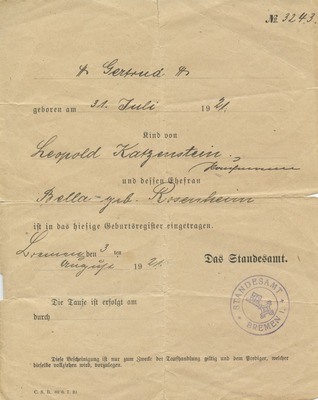
Gerdy Katzenstein and her parents were able to emigrate to the United States just after Kristallnacht in December, 1938. Having worked in Germany, the Katzensteins would doubtless be seen as immigrants who would not be a burden on the state. Gerdy and her family petitioned for a name change to Kaston.
See 2012.1.39 and 2012.1.566
Adele Bertha Levy was a 55-year-old widow from Hanover, Germany who found refuge in Manila, Jews having been welcomed to go to the Philippines by President Manuel Quezon. Adele was one of 1300 Jews fleeing Nazi Germany who became part of an active Jewish community in the Philippines. The Filipinos themselves were welcoming and helpful to the Jews, and this would be reciprocated by the refugees. Adele was ultimately seeking to go to the United States to be with her two children. She reached San Francisco on December 30, 1941.
See: 2022.1.37 and 2022.1.38a-e
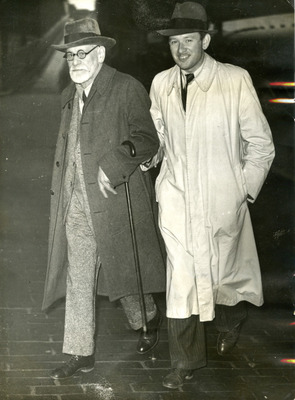
Dr. Sigmund Freud at age 82 arrived in London in June 1938, where he would live with his wife and daughter Anna, having fled his native Austria after the Anschluss, Austria’s annexation by the German Reich on March 12, 1938. Freud would not return, having died in September 1939.
See 2014.1.87 Dr. Freud Arrives in London as Refugee
Passengers on the Pentcho, an old malfunctioning Danube paddle-steamer carrying 400 refugee Slovakian and German Jews from Bratislava, Slovakia were bound for Palestine in May 1940, attempting to escape Nazi persecution under President and Priest Josef Tiso. The Pentcho picked up 100 more refugee Austrian Jews along the way and continued to Palestine.
During the arduous journey the ship’s boiler exploded in Italian territory causing the Pentcho to split in two. The passengers, marooned on a deserted island, were eventuallyspotted by a plane, and brought to the island of Rhodes - during the War under Italian control - where they lived for the next 15 months in a sports (soccer) stadium guarded by Italian soldiers but aided by members of the indigenous Rhodes Jewish community who brought them food and supplies. Transferred in January 1942 to Ferramonti internment camp in southern Italy, they lived among other “enemy aliens,” until they were liberated by the British army in 1943. Most of the refugees successfully emigrated to Palestine, although a number were sent to the Fort Ontario refugee center in upstate New York.
See the subcollection THE VOYAGE OF THE PENTCHO
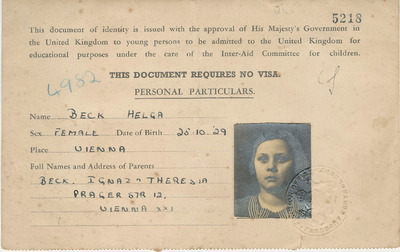
Helga Beck at age 10 made her journey from Vienna to Great Britain in 1939 with the Kindertransport, a rescue effort by various groups that placed children with foster families primarily in the UK.
See 2022.1.41 and the subcollection WHAT THEY CARRIED: THE KINDERTRANSPORT
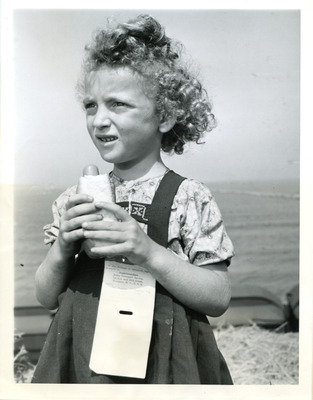
Dorrit Blumenkranz was six years old in 1944 when she went from Vienna to the only camp for refugees in the United States: Fort Ontario in Oswego, NY.
See 2014.1.46 One of 982 Jewish Refugees at Fort Ontario, Dorrit Blumenkranz Samples a Hot Dog









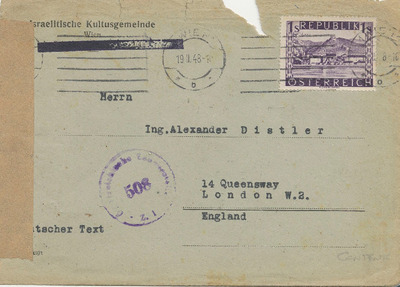

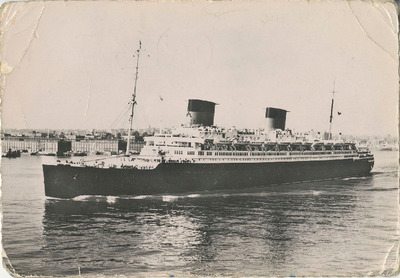


-
Birth Certificate for Gertrude Katzenstein, Daughter of Leopold Katzenstein and Bella Katzenstein
2012.1.39
Tan document with serial number 3243 and writing in black ink.
Information Provided by Michael D. Bulmash: Gertrude Katzenstein, a German citizen who was able to escape Nazi Germany and emigrate to America.
[Items relating to Gertrude Katzenstein: 2012.1.38ab, 2012.1.39, 2012.1.40, 2012.1.94, 2012.1.95ab, 2012.1.566]
-
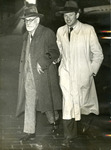
Dr. Freud Arrives in London as Refugee
2014.1.87
Front: An image of Dr. Sigmund Freud accompanied by a younger man. Back: A typed description of the photo.
Information Provided by Michael D. Bulmash:
Photo shows an 82-year-old Sigmund Freud, Austrian pioneer of psychoanalysis, arriving at Victoria Station in London, June 6, 1938, not long after the "Anschluss". According to the information provided on the wire photo by Planet News, he is intending to make his home in London (his daughter works there). " Dr. Freud, who is Jewish, had his passport restored to him unexpectedly by the Nazi authorities. He was allowed to take out of Austria only his furniture, his library, and his collection of Greek and Egyptian antiques."
-
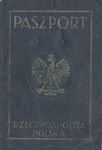
Passport of Josef Heidenstein and the Polish Action
2022.1.59
Blue booklet with bird with crown in circle on cover, includes photograph on pages 3 and 9 of 40 pages, no stamps on pages 24-40.
Information Provided by Michael D. Bulmash:
Mr. Heidenstein’s German passport documents the events surrounding the Polenaktion. His passport was issued in Berlin in 1936. He was deported by the police to Poland on October 28, 1938 (p. 9). He would be in a refugee “camp” on the Polish and German border in Nowy Tomysi , a town just a few miles from the Grynszpans in Zbaszyn. Poles applied the Ministry of Interior stamp for the special committee for those deported from Germany (p. 7), as well as border stamps indicating his deportation.
Mr. Heidenstein survived, travelling in 1939 via Belgium and Holland for the U.K. His passport was extended in London in 1940.
-
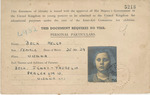
ID Issued to Ten-Year-Old Member of the Kindertransport Helga Beck from Vienna, Austria for Admission to Harwich, UK
2022.1.41
recto : photograph is lower right corner with raised stamp at lower right corner; ‘5218’ printed at top right corner; verso: green and blue dated handstamps from Exeter and Harwich.
Information Provided by Michael D. Bulmash:
Helga Beck’s identification card accompanied her on her journey from Vienna to England in 1939. Helga’s journey to the UK with the Kindertransport occurred six months after the Kristallnacht pogrom in Austria. The information on the card is as follows: Recto: “THIS DOCUMENT REQUIRES NO VISA” - in other words, it serves as passport and visa for purposes of the Kindertransport to England. It provides her name, sex, place of birth, and names and place of residence of her parents: Vienna, Austria. Verso: two hand-stamped seals: Exeter City Police, 3 November 1945 with alien registration number. Also included: permission to land in Harwich 15 May 1939, an accompanying photo of Helga, and the stamp of passport control. Her number at top right: 5218.
-
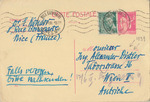
Postcard from Doctor in Nice, France to Alexander Distler, Engineer in Austria
2019.2.310
Postcard with red and green postage, “CARTE POSTALE” printed in red near top, addressed to Alexander Distler in blue. Back dated “14.VI.39” in upper right corner in blue.
Information Provided by Michael D. Bulmash: Postcard, written in German, addressed to Alexander Distler, an Austrian engineer living in Vienna, just three weeks before he becomes a refugee fleeing Nazi-occupied Austria for Great Britain.
[Related items 2019.2.311ab - 2019.2.323]
-
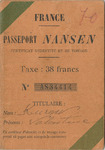
Rare Late-Issue "Nansen" Passport with Visa Signed by Aristides de Sousa Mendes for Woman Fleeing France for Safety
2023.1.10
‘FRANCE PASSEPORT NANSEN’ on cover; orange with green stripes at top left and lower right of cover; photograph on page 3; pages 16-17 blank; accordion fold
Information Provided by Michael D. Bulmash:
Valentine Kurow was a 34-year-old Jewish woman originally from the seaport town of Odessa in Russia. She had fled Russia with her mother just after the Revolution in 1917 and the ensuing civil war. She was apparently an opera singer from information obtained on a Brussels, Belgium work permit she had completed in 1939. She cited impresario Jean van Glabbeke of the Théatre Royal de la Monnaie in Brussels where in 1939 she may have sung in the opera Carmen. In any case, she found herself in Bordeaux, France just ahead of the German invasion on May 10, 1940, a stateless immigrant along with thousands of Jews fleeing south attempting to escape the advancing Nazi juggernaut. On June 5, 1940, diplomat Aristides de Sousa Mendes, the Consul General in the Portuguese Legation in France, signed a Portuguese visa for her, and Valentine was able to cross into Portugal and sail from Lisbon to the United States on the Exeter on July 18, 1940.
This story is all the more remarkable because de Sousa Mendes himself was at this time undergoing a crisis of conscience. Rabbi Chaim Kruger, a Belgian refugee, had prevailed upon de Sousa Mendes, a devout Catholic, to issue visas for all Jewish refugees. After an initial demurral, and a firm refusal on the part of the Rabbi to accept visas for his own family unless all Jews were served, de Sousa Mendes capitulated and, “standing with God against man,” defied Salazar and the notorious “Circular 14” and began issuing lifesaving visas to all refugees. For his sustained defiance of his orders and his actions on behalf of the beleaguered Jews, de Sousa Mendes would be dismissed from service by Salazar and denied retirement benefits for his large family. (See 2022.1.19ab)
The passport itself is a French “Nansen” passport, issued to Ms. Kurow in Paris, France on August 22, 1939, and numbered 27.699. Her photograph is on page 3. Nansen passports were first issued in 1922 by the League of Nations to manage the staggering refugee crisis after World War I. In the wake of that war, governments were upended, national boundaries redrawn with some nations absorbed by other nations, thus creating enormous chaos for stateless refugees trapped in the untenable situation of trying to find sanctuary in countries where they did not fear persecution but lacked the requisite identity documents and proof of nationality to cross borders legally. Many no longer had passports, making international travel virtually impossible. The first Nansen passport was a recognition of the need on the part of both the International Red Cross and the League of Nations to create identity certificates for refugees from the civil war following the Russian Revolution, with the new government of the Soviet Union revoking the citizenship of Russians living abroad, and with the refusal of many former citizens to return. Fridtjof Nansen convened the first conference on this crisis to provide stateless refugees with international protection by way of a travel and identity instrument that gave them an identity and legitimacy. The so-called Nansen passport would in time be recognized by fifty governments.
-
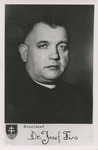
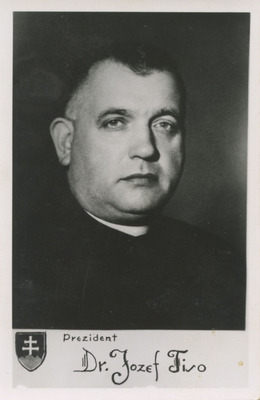
Josef Tiso Postcard
2012.1.373
Postcard with black and white photograph of Josef Tito, an older man wearing black. Includes blank postcard lines on back.
Information Provided by Michael D. Bulmash: Josef Tiso (1887-1947) was a Slovak politician and priest, head of the Nazi satellite Slovak state and involved in the deportation and massacre of Jews. He was convicted and hanged at war's end.
-
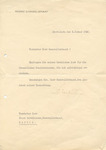
Letter From Josef Tiso
2012.1.372
Tan paper with "Prezident Slovenskej Republiky" (President of the Slovak Republic) letterhead. Includes typewritten message and signature in faint ink.
Information Provided by Michael D. Bulmash: Josef Tiso (1887-1947) was a Slovak politician and priest, head of the Nazi satellite Slovak state and involved in the deportation and massacre of Jews. He was convicted and hanged at war's end. This letter was written on Presidential letterhead to General Lieutenant Franz Barackhausen, German General of Artillery, in part "... Please accept my heartfelt thanks for your friendly new year's wishes which I sincerely reciprocate..." At the time of this letter, Franz Barackhausen was serving as head of the German military mission in Slovakia.
-
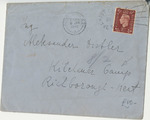
Correspondence to Alexander Distler, an Austrian Internee of Camp Kitchener, from Richborough, Kent, United Kingdom
2019.2.311ab
a: Blue envelope addressed to Alexander Distler with red postage stamp in upper right corner, stamped with date “8 JAN 1940.” b: Blue letter, writing fills entire front and back page.
Information Provided by Michael D. Bulmash:
This letter, written in German, was sent to Kitchener refugee "Aleksander" Distler by a Rose Engel, possibly a refugee, now a London Jewish resident, as the letter was postmarked in Paddington.
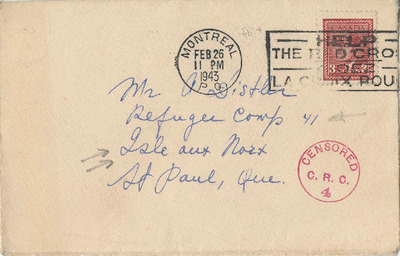
Cancelled in Montreal February 26, 1943, Canadian hand stamp censor marks (Commission for Refugee Camps censored refugee mail circular C.R.C. and numbered handstamp) on cover and on letter, and Ile-aux-Noix censor mark cover verso. Distler receives this letter written in English while continuing to reside at the Ile-aux-Noix camp for “illegal aliens” in Canada. The camp closed the end of December 1943.
[Related items 2019.2.310 - 2019.2.323]
-
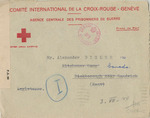
Red Cross Correspondence from Franziska Distler in Nazi-Occupied Vienna to Alexander Distler, Interned in Camp I, Ottawa, Canada
2019.2.312ab
a: Envelope “COMITÉ INTERNATIONAL DE LA CROIX-ROUGE-GENÈVE” addressed to “Mr. Alexander DISLER.” B: Document with Red Cross symbol in upper left corner, marked “Deutsches Rotes Kreuz,” stamped with date “10 AUG 1940” near top.
Information Provided by Michael D. Bulmash:
Alexander Distler, Polish-born civil engineer and architect residing in Vienna, fled to Great Britain after Kristallnacht and was placed with other refugees in Kitchener Camp in Richborough Kent. Distler was one of 6,000 refugees to escape Germany, Austria, and Czechoslovakia for Great Britain. Britain’s fear of a war with Germany, however, meant that many of the refugees would be treated as possible “enemy aliens”. Distler would be deported to Canada and confined to Camp I. He had been in contact with his mother Franziska Distler in Vienna who was apparently unaware that “Aleksander” had relocated and was concerned that she had not heard from him. In one letter eventually reaching him in Camp I she expresses her sadness over the lack of communication and hopes he is well (2019.2.321ab). She asks him to be “lighthearted.” Messages within the Greater Germany (including Austria) were sent by way of the Red Cross and forwarded to their respective destinations. Only 25 words were allowed both front and back, and the mail was censored.
[Related items 2019.2.310 - 2019.2.323]
-
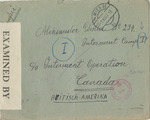
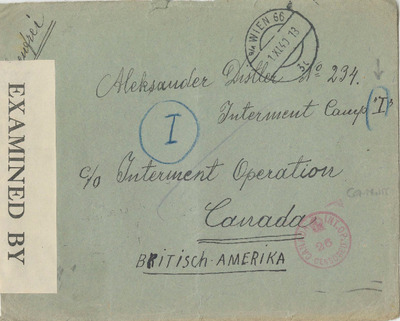
Correspondence from Franziska Distler in Vienna to Alexander Distler, Interned in Camp I, Ottawa, Canada
2019.2.313ab
a: Green envelope labeled “EXAMINED BY” on front and “CENSOR” on back, addressed to “Aleksander Distler”, large “I” written and circled in blue in center, “BRITISCH AMERIKA” written and underlined at bottom. b: Letter stamped with “CENSORED CANADA IN.T.O.P. 26” near top left, dated “1. November 940” in upper right corner.
Information Provided by Michael D. Bulmash:
Mrs. Distler, Alexander Distler’s mother, is living in Vienna, at this time part of the “Greater Germany” subsequent to the Anschluss of March 12, 1938, which is indicated in her return address. Her letter to Alexander is postmarked in Vienna with a double-ring cancellation and censored in Austria and Canada with sealing tape and a red hand stamp.
[Related items 2019.2.310 - 2019.2.323]
-
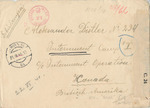
Correspondence from Franziska Distler in Vienna to Alexander Distler, Interned in Camp I, Ottawa, Canada
2019.2.314ab
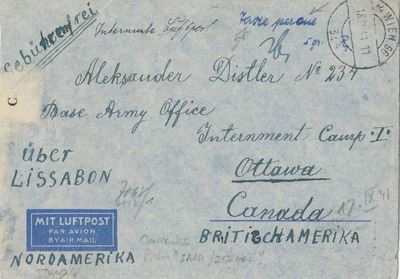
a: Envelope addressed to “Aleksander Distler No. 234,” “Internment Camp “I” written in center, “internment underlined twice, “I” circled in blue. b: Small letter dated “22. 12. 940” in upper right corner, stamped with “CENSORED CANADA IN.T.O.P. 27” in red in upper left corner.
Information Provided by Michael D. Bulmash:
Mrs. Franziska Distler, Aleksander’s mother, is living in Vienna, at this time part of the “Greater Germany” subsequent to the Anschluss of March 12, 1938 which is indicated in her return address. Her letter to Aleksander, internee number 234 at Camp “I,” is postmarked in Vienna with a double-ring cancellation and censored in Austria and Canada with sealing tape and red hand stamp.
[Related items 2019.2.310 - 2019.2.323]
-
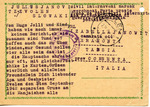
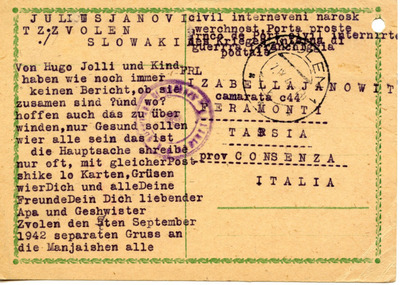
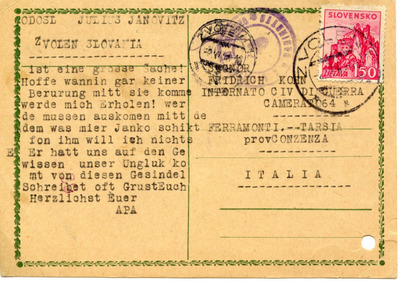
Postcard from Slovakia to Ferramonti di Tarsia Internment Camp
2014.1.359
Front: Green border; two indecipherable circular hand stamps; typed text; hole punch at top right corner. Back: Typed text filling up entirety of back.
Information Provided by Michael D. Bulmash:
Postcard from Julius Janovitz from Slovakia to family member Izabela Janovitz, who had been a passenger on the ill-fated Pentcho and, having been on the island of Rhodes, under Italian control, quartered in a stadium, has by the time of this writing been moved, along with most of the passengers, to the Ferramonti di Tarsia internment camp.
Ferramonti, near Tarsia in Southern Italy, was the largest Italian concentration camp. Opened in June 1940, Ferramonti held almost 4000 Jewish prisoners, most of whom were refugees from Germany. It was neither a slave labor camp nor an extermination center along the lines of German and Polish camps. Indeed, inmates were treated well, and there were organized cultural activities, a library, and a synagogue. After Mussolini’s downfall in 1943, many internees at Ferramonti either joined the Allied war effort or were transferred to Camp Oswego in New York.
-
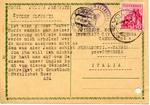
Postcard from Slovakia to Ferramonti di Tarsia Internment Camp
2014.1.360
Front: Green border; red 'Slovensko' postage stamp in top right; three circular hand stamps; typed text. Back: Typed text filling up entirety of page.
Information Provided by Michael D. Bulmash:
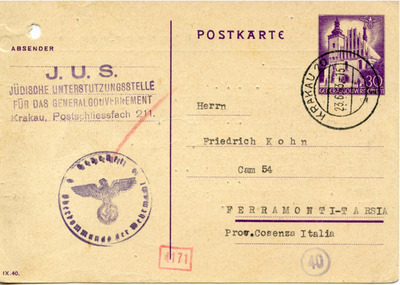
Julius Janovitz from Zvolen, Slovakia here corresponds with Fridrich Kohn, another internee of the Ferramonti di Tarsia Italian internment camp who was possibly a passenger on the Pentcho.
-
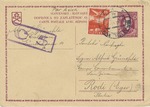
Censored Airmail Postcard from Bratislava, Slovakia to Alfred Grunsfeld at “Concentration Camp” San Giovanni on the Island of Rhodes
2019.2.357
Front: floral burgundy border, purple 'C5' handstamp, addressed to Alfred Grunsfeld. Verso: handwritten message with purple 'C5' handstamp in center
Information Provided by Michael D. Bulmash:
This camp is in an old sports stadium on the island of Rhodes for interned civilians during wartime. Sent by relative in Bratislava, Slovakia.
-
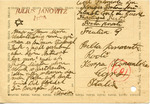
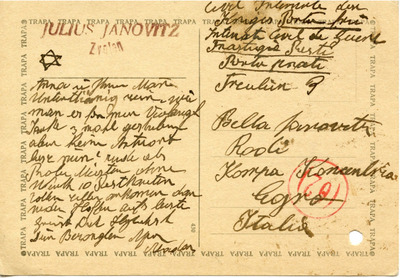
Postcard from Slovakia to Rhodes
2014.1.361
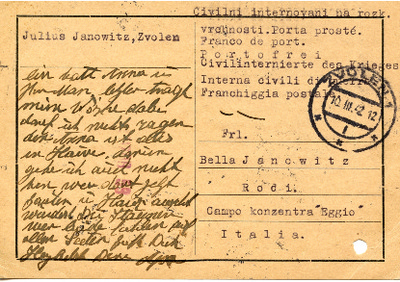
Front: 'Trapa' repeated along edge to create a border; drawing of Star of David in upper left corner. Back: Handwritten text, Large black ink blot on top.
Information Provided by Michael D. Bulmash:
Postcard from Julius Janovitz to Bella Janovitz, whom he refers to as a civilian intern of war, and as a former passenger on the ill-fated Pentcho, is now in the “concentration camp” on the island of Rhodes. Interesting is the drawing of the Star of David recto. Julius, who was perhaps Bella’s father, perished in the war. Bella was ultimately to be relocated to the Italian internment camp of Ferramonti di Tarsia and survived the war.
-
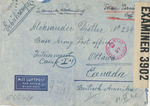
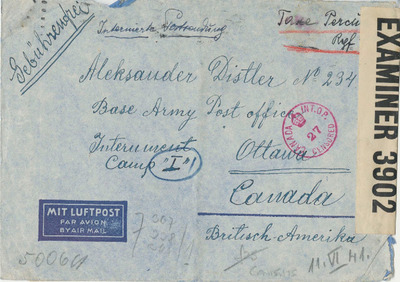
Correspondence from Franziska "Sara" Distler in Vienna to Alexander Distler, Interned in Camp I, Ottawa, Canada
2019.2.315ab
a: Envelope labelled “EXAMINER 3902” on right side, “MIT LUFTPOST” printed in blue box in bottom left corner, “OTTAWA CANADA” underlined and written in blue. b: Letter on thin, translucent paper, green writing on both sides, “CENSORED CANADA IN.T.O.P. 27” stamped in red in each corner.
Information Provided by Michael D. Bulmash:
In accordance with the Nuremberg Laws, which also apply in Austria, Mrs. Franziska Distler, as a Jew, must use the name “Sara” in her correspondence, as is indicated in her return address. In this letter we can see that inserting the name “Sara” is an afterthought. Her letter to Aleksander is sent airmail, censored in Austria and Canada with sealing tape and red hand stamp. Another man whose signature is difficult to read appears to share the same address as Mrs. Distler, who signs his name on the return address with the obligatory “Israel” for male Jews.
[Related items 2019.2.310 - 2019.2.323]
-
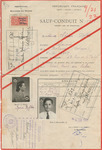
Safe-Conduct Pass for Jewish Mother and Child Caught in Vichy, France
2022.1.39
Form bordered in red with two diagonal red stripes through page; two photographs and multiple stamps on front and back
Information Provided by Michael D. Bulmash:
Vichy France travel document for Ryfka and Emile Spira, a Jewish mother and her 11-year-old son, both of Polish origin who found themselves in Vichy, France, during the occupation, thankfully avoiding the infamous January 1943 systematic roundup of 2,000 Jews of Marseilles by the Germans in concert with the French Gendarmes, orchestrated by the collaborationist Vichy regime and Pierre Laval. The Jews in this roundup were sent to the internment camp at Drancy and from there deported to Auschwitz. The Spiras were given a Cuban visa at Marseilles by Marino Estrada, Consul of Cuba in Marseilles (at the same time Hiram Bingham IV was Vice-Consul of the United States in Marseilles). They traveled to Seville, Spain and boarded a ship for Cuba where they were able to obtain an entry visa issued by George R. Hukill to reach New York.
-
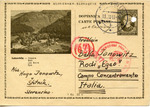
Censored Postcard to Bella Janowitz Interned in “Concentration Camp” on Island of Rhodes
2014.1.356a
Front: Image of a large estate at the base of mountains with 'Lubochna - Spa' caption below; handwritten address with red and black circular hand stamps, 'Slovenska Posta' postage stamp with figure in profile. Back: Handwritten note dated July 10, 1941.
Information Provided by Michael D. Bulmash:
Postcard sent by relative in Slovakia.
-
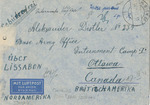
Correspondence from Franziska "Sara" Distler in Vienna to Alexander Distler, Interned in Camp I, Ottawa, Canada
2019.2.316ab
a: Blue envelope addressed to “Aleksander Distler No. 234,” “NORDAMERIKA” written in bottom left corner under “MIT LUFTPOST” printed in blue box, “OTTAWA CANADA” underlined and written in blue in bottom right corner. Letter on thin, translucent paper, green writing on one side, date “17. September 941” written in top right corner.
Information Provided by Michael D. Bulmash:
In accordance with the Nuremberg Laws, which also apply in Austria, Mrs. Franziska Distler, as a Jew, must use the name “Sara” in her correspondence, as is indicated in her return address. In this letter we can see that inserting the name “Sara” is an afterthought. Her letter to Aleksander is sent airmail, censored in Austria and Canada with sealing tape and red hand stamp. Another man whose signature is difficult to read appears to share the same address as Mrs. Distler, who signs his name on the return address with the obligatory “Israel” for male Jews.
[Related items 2019.2.310 - 2019.2.323]
-
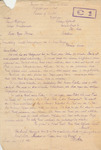
Censored Letter from Margit Heitlinger, a Former Passenger on the Steamer Pentcho
2019.2.302
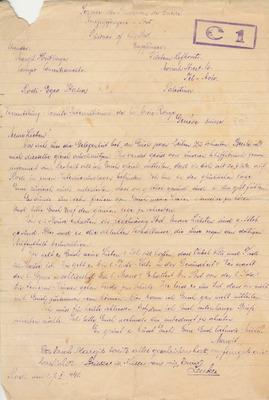
Lined letter written in purple with large “C 1” stamped in purple in top right corner.
Information Provided by Michael D. Bulmash: Censored letter written by a 20-year-old Jewish refugee, Margit Heitlinger, about her experiences on the island of Rhodes, assuring her aunt in Tel Aviv, Palestine that having survived the shipwreck, she is in the “fortunate area” of the island (probably the Rhodes soccer stadium).
-
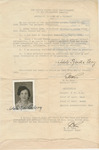
Affidavit for Stateless Refugee Adele Bertha Levy
2022.1.37
‘THE UNITED STATES HIGH COMMISSIONER’ is typewritten at the top center of the document, photograph is stapled at bottom left quadrant with signature spanning from paper to photo to paper.
Information Provided by Michael D. Bulmash:
Throughout the 1930s and World War II, the United States government under the Roosevelt Administration and other Western Nations closed their doors to Jewish refugees fleeing Europe. Jewish flight to Shanghai is well-known, a city which did not require entry visas until 1939. Less familiar is the asylum provided by the government of the Philippines to more than 1,300 Jews fleeing Nazi Germany, and the support offered by its president Manuel Quezon, who asked all Filipinos to welcome them and help with assistance. A refugee committee was established and American Jewish organizations such as the Joint Distribution Committee helped with funding. Contributions were also received from relatives of the refugees to increase the prospect of refugees being admitted. Indeed, the process of admission was selective and certain criteria had to be met in terms of desirable professions that would benefit Filipinos. The process of admission was selective. By the end of the war many surviving refugees would migrate to the U.S.
Adele Bertha Levy was a 55-year-old German Jewish woman, widowed, from Hanover who fled Nazi Germany and found refuge in the Philippines. She was a resident of Manila.
She was seeking to go to the United States to be with her children in California. Stateless and without a passport, she received in Manila an “Affidavit in Lieu of a Passport '' on October 27, 1941 by a passport agent in Manila. Her photograph is on the Affidavit along with personal characteristics. The visa (verso) - No.1150 - was issued on November 10, 1941, under a statute related to quotas on immigrants. She was able to leave Manila November 25, on the SS President Coolidge with a brief stop in Hawaii on the 17th of December - just 10 days after Pearl Harbor was bombed by the Japanese. The Japanese invaded the Philippines on December 8th. She reached the US (San Francisco) on December 30, 1941.
[Related item: 2022.1.38a-e]
-
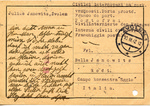
Censored Postcard to Bella Janowitz, Civilian Intern in “Concentration Camp” on Island of Rhodes,
2014.1.356b
Front: handwritten note, typed address to Bella Janowitz, black circular hand stamp. Back: Handwritten note.
Information Provided by Michael D. Bulmash: Postcard sent by relative in Zvolen, Slovakia.
-
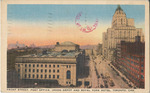
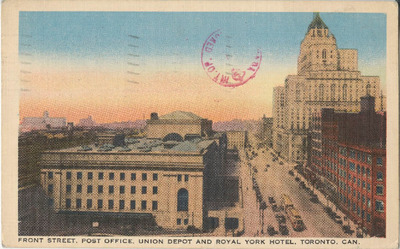
Postcard to "Ingenieur" Alexander Distler in Jewish Refugee Camp 41 Ile-aux-Noix, Quebec from Carl Radlmesser in Toronto
2019.2.317
Postcard with color image of city street, labelled “FRONT STREET, POST OFFICE, UNION DEPOT AND ROYAL HOTEL, TORONTO, CAN.” Back has two green postage stamps in upper right corner.
Information Provided by Michael D. Bulmash:
Due to Great Britain’s concern about the infiltration of “enemy aliens” among Jewish refugees, Alexander Distler had been sent to internment camps in Canada. At some point after 1940 the name of Camp I was changed to Camp 41, on Ile-aux-Noix, an island in Quebec. Distler may have known Radlmesser from Austria, but most certainly knew him from his time at Camp Kitchener in Richborough, Kent, as both names appear on a list of “residents.” Radlmesser reports that he is doing well, working on a farm near Toronto, and hopes to hear from Distler.
[Related items 2019.2.310 - 2019.2.323]
-
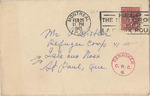
Correspondence from Montreal to Alexander Distler in Refugee Camp 41, Ile-aux-Noix, Quebec
2019.2.318ab
a: Envelope with address “Mr. A Distler, Refugee Camp 41, Isle aux Noix, St Paul, Que.” Written in blue, includes red postage stamp, stamped in black with “MONTREAL FEB 26 11 PM 1943.” b: Letter with writing on front and back, “Dear Mr. Distler:” written in top left corner.
Information Provided by Michael D. Bulmash:
Letter cancelled in Montreal February 26, 1943, Canadian hand stamp censor marks (Commission for Refugee Camps censored refugee mail circular C.R.C. and numbered handstamp) on cover and on letter, and Isle-aux-Noix censor mark cover verso. Distler receives this letter written in English while continuing to reside at the Isle-aux-Noix camp for “illegal aliens” in Canada. The camp closed the end of December 1943.
Miss Lonse (?) from Montreal writes Distler that “It is rather a great quandary to me why you never answered my letters. I believe they never reached you.” She wonders how he feels and that others, including her sister, send their regards.
[Related items 2019.2.310 - 2019.2.323]