

Preview
Creation Date
570/1
Geography
Minted in Constantinople
Culture
Byzantine
Medium
Copper
Dimensions
30 mm
16 g
Credit Line
Long-term Loan from Brad Hostetler, 2025
Accession Number
2025.9
Condition
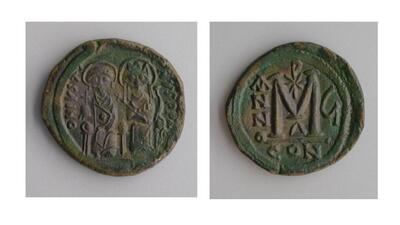
The obverse side of the coin is offstruck to the right, while the reverse side is offstruck to the left. Both sides of the coin are oxidized, giving the bronze material a green hue. The oxidation occurs primarily on the fields of the coin, being less evident on the central device. On both sides of the coin there is clipping along the outer rim. Both sides are depicted in low relief, but have most likely been worn down from their original relief. The obverse side of the coin is worn, with three clippings along the rim towards the top edge. (December 2024)
References
Alfred R. Bellinger, Catalog of Byzantine Coins in the Dumbarton Oaks Collection and in the Whittemore Collection, vol.1, Anastasius I - Maurice, 491-602 (Washington, DC: Dumbarton Oaks Center for Byzantine Studies, 1966) p. 208 (DOC 30). Note that this particular specimen, with the Δ officina mark, is not included in the catalog.
Description
This is a copper alloy coin, termed a follis. It is from the reign of Justin II, who ruled from 565 to 578, and was made during the year 570/1, six years into Justin’s rule. Its numerical value during Justin’s reign was 40 nummi, as indicated by the large Mu on the reverse.
On the obverse we see Emperor Justin II and Empress Sophia adorned in jewelry. They are frontal and appear seated. The figures take up the majority of space on the coin, and the surrounding inscription translates to “Our Lord Justin, eternal augustus”. Justin is wearing a loros that reaches his feet and holds a globus cruciger in his right hand. Beside him, Empress Sophia wears a tunic covered by a jeweled necklace, and is shown as slightly larger than Justin. This may allude to Sophia’s growing authority prior to Justin’s steep mental decline in 572, which is reflected in her later organization of Tiberius II’s adoption as Justin’s successor. She is wearing a crown below her halo and holds a cruciform scepter in her right hand, asserting her political and religious authority. On either side of each figure, there is a tall cross topped by a droplet-like loop, around the edges of the throne they sit upon.
On the reverse of the coin, we see a series of high relief capped lines forming the letter “M”, denoting the coin’s value. A Christogram, or monogrammatic abbreviation for the first two letters of Christ’s name, appears above all else on the coin , emphasizing the integration of imperial and divine authority. This may allude to the emphasis on imperial and divine power as a response to conflict between the Miaphysites and Orthodox Christians. Justin was tolerant of the Miaphysites at first, but unsuccessful efforts to reconcile both parties resulted in him issuing an anti-Miaphysite creed in 571. Inclusion of religious items and features on coinage asserts Justin and Sophia’s divine authority and imperial rule in the face of conflict. To the left of the M, four vertical letters spell the Latin word “ANNO”, or “year of”. On the other side of the M is the Greek symbol stigma, indicating this coin was made in his sixth reigning year, 570/1. The letters “CON”, short for Constantinople, denote the mint location of the coin. Directly below the lower point of the M, appears the Greek symbol delta, indicating the officina, or the workshop in which the coin was made. This coin is an indication of the turbulence of Justin’s reign, which faced religious conflicts within the empire, and alludes as well to his own declining mental state.
Leah Ullman (Florida State University, ’27) for ARH 2020 Reading and Writing Art History (fall 2024), taught by Dr. Lynn Jones.
Obverse
2025.9_003.jpg (489 kB)
Reverse
2025.9_obverse_diagram.jpeg (583 kB)
2025.9_reverse_diagram.jpeg (519 kB)
Keywords
Before 600 CE, Byzantine Art