

Preview
Creation Date
575/6
Geography
Minted in Antioch
Culture
Byzantine
Medium
Copper
Dimensions
32.4 mm
14.6 g
Credit Line
Long-term Loan from Brad Hostetler, 2025
Accession Number
2025.8
References
Alfred R. Bellinger, Catalog of Byzantine Coins in the Dumbarton Oaks Collection and in the Whittemore Collection, vol.1, Anastasius I - Maurice, 491-602 (Washington, DC: Dumbarton Oaks Center for Byzantine Studies, 1966) p. 245 (DOC 158a).
Description
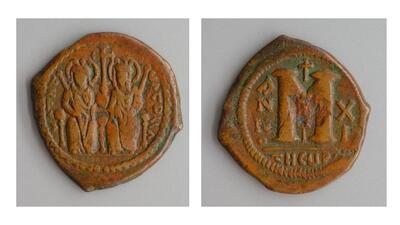
This copper alloy coin, termed a follis, is from the reign of Justin II, who ruled from 565 to 578, in Early Byzantium. He was part of the Justinian dynasty. On the obverse, we see the emperor Justin II and his wife Sophia sitting fully frontal on their thrones. Justin succeeded his uncle Justinian, and Justinian’s wife, Theodora, was Sophia’s aunt. Therefore, Justin’s marriage to Sophia strengthened his claim as Emperor. They each hold a staff, and are adorned in imperial regalia and regal headwear, and both are nimbate, meaning they wear halos.
Between them, is a globus cruciger. On both sides of Justin and Sophia, there is blundered inscription. Their facial features are indistinguishable, so it is initially difficult to differentiate between who is Justin and who is Sophia. They both appear to be the same size, they each hold the same things, and both have halos. The only way to distinguish between the two is that the figure on the left has pendilia. Pendilia are pendants that dangle from metal headwear, such as a crown. This indicates that the figure on the left is Justin. This decision to portray them as equals was perhaps intentional, as Sophia had a large influence on Justin’s reign. One could even say they had a joint reign. Towards the end of his reign, following a series of military losses, Justin developed a mental illness that brought on attacks of insanity.This led him to step down from his role as emperor and allowed Tiberios II to rule in his place. During this time, Sophia continued to rule as Augusta, even procuring a truce with Chrosoes, the king of Persia, that lasted until Spring of 577.
On the reverse we see a large M, which is the Greek letter, mu. This indicates the denomination, which is equal to 40 nummi. 40 nummi in the Byzantine Empire could buy very basic necessities, such as a single loaf of bread. Above the M at the 12 o’clock position there is a cross. Underneath the M at the 6 o’clock position, we see the officina mark, gamma, which tells us the workshop this coin was minted in. On the left side of the coin, from top to bottom is the inscription A/N/N/O which means year, and on the right side from top to bottom is the inscription X/I. These inscriptions tell us that this coin was minted in the 11th year of Justin’s reign, 575/6. Along the bottom from left to right the inscription THEUP, appears. This is the mint city, Theopolis, a historical name for Antioch.
Faith Granger (Florida State University, ’26) for ARH 2020 Reading and Writing Art History (fall 2024), taught by Dr. Lynn Jones.
Obverse
2025.8_003.jpg (589 kB)
Reverse
diagram 1.pdf (50 kB)
2025.8_obverse.jpg (76 kB)
2025.8_reverse.jpg (61 kB)
Keywords
Before 600 CE, Byzantine Art