

Preview
Creation Date
590/1
Geography
Minted in Cyzicus
Culture
Byzantine
Medium
Bronze
Dimensions
26 mm
12.14 g
Credit Line
Long-term Loan from Brad Hostetler, 2025
Accession Number
2025.4
Condition
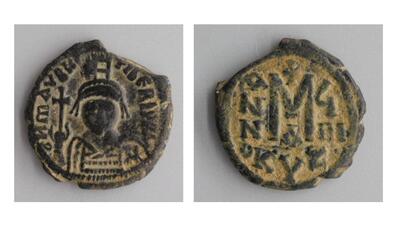
The coin has a large chip along the edge, running from the 12 o’clock to the 2 o’clock positions, when viewing the front. Also visible are some scratches and wear (particularly noticeable on the nose and mouth) from age and being passed from hand to hand, but on the whole, this coin is in excellent condition when compared to similarly dated coins. It is possible that this coin was buried, either as an intentional saving technique, or accidentally, if the coin was dropped or discarded. (December 2024)
References
Alfred R. Bellinger, Catalog of Byzantine Coins in the Dumbarton Oaks Collection and in the Whittemore Collection, vol. 1, Anastasius I - Maurice, 491-602 (Washington, DC: Dumbarton Oaks Center for Byzantine Studies, 1966) p. 332 (DOC 126a).
Description
This coin is from the reign of Emperor Maurice, who ruled the Byzantine Empire during the Early Byzantine period, from 582 to 602. This is a copper alloy, or bronze, coin, termed a follis. It was minted in 590/1 in Cyzicus, in modern-day Turkey.
Starting with the obverse we see Maurice, centered. He holds a globus cruciger in his right hand, which is a prop made of a globe (representing the world that the emperor holds power over) and a long cross (representing the religion of the empire). He also wears a cuirass (breastplate) with a cloak and has a shield slung over his left shoulder. The symbol on the shield is difficult to make out, but it may be a four-legged animal like a horse which would reflect a military affinity. Maurice is best remembered for his military career and eventual death brought about by the revolt of his own army. While he was not privy to the eventual irony of his demise, he makes a very intentional decision to depict himself as a military official.
The helmet is of note because it differs from contemporary crowns, including the one typically associated with Maurice. While the helmet shown on this coin has pendilia, that is, the hanging jewels and pearls, the tuft of the helmet sticks straight up rather than going too far left or right. It also has an additional horizontal line that none of the other 17 crowns of the period seem to have (See Philip Grierson, Catalogue of the Byzantine Coins in the Dumbarton Oaks Collection and in the Whittemore Collection, vol. 2, Phocas to Theodosius III, 602–717 [Washington, DC: Dumbarton Oaks Research Library and Collection, 1968], p. 82, table 9). This suggests that the crown’s appearance on this coin is less common, possibly because it was minted in Cyzicus rather than the capital, Constantinople.
On the reverse we see an exciting jumble of letters and symbols. The “mu” in the center refers to the coin’s value (40 nummi), and “ANNO” down the left side means “year of.” The Greek letter “stigma” represents the number 6, and when combined with the Roman numeral for 3, we learn that this coin was minted nine years after emperor Maurice came into power (590/1). KYZ in the exurgue refers to the minting location, Cyzicus.
Before becoming emperor, Maurice wrote a treatise on military strategy — The Strategikon — which shaped his later decision during the last Roman-Persian War to order his army to attack the Slavs in the winter when they would be “more vulnerable.” But as it turned out, the army, led by the soldier Phokas, disliked the cold, harsh conditions and limited resources, leading them to revolt and allowing Phokas to overtake the capital in 602. He crowned himself emperor, assassinating Maurice and his sons. Phokas only reigned for eight years, until 610, before he himself was usurped by Heraclius.
Alyson Swindler (Florida State University, ’26) for ARH 2020 Reading and Writing Art History (fall 2024), taught by Dr. Lynn Jones.
Obverse
2025.4_003.jpg (646 kB)
Reverse
2025.4_diagram_reverse.jpeg (1204 kB)
2025.4_diagram_obverse.jpeg (1301 kB)
Keywords
Before 600 CE, Byzantine Art