

Preview
Creation Date
591/2
Geography
Minted in Antioch
Culture
Byzantine
Medium
Copper alloy
Dimensions
27.9 mm
12 g
Credit Line
Long-term Loan from Brad Hostetler, 2025
Accession Number
2025.3
Condition
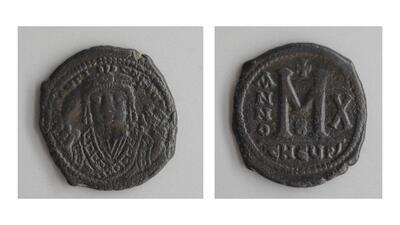
The facial features of the figure are worn or blundered, and this is seen most obviously in the nose and mouth. The overall condition of the coin is better on the reverse. (December 2024)
References
Alfred R. Bellinger, Catalog of Byzantine Coins in the Dumbarton Oaks Collection and in the Whittemore Collection, vol. 1, Anastasius I - Maurice, 491-602 (Washington, DC: Dumbarton Oaks Center for Byzantine Studies, 1966), p. 34 (DOC 162b).
Description
This coin, made of copper alloy, is a follis, minted during the reign of Maurice who ruled from August 582 to November 602. Originally from Armenia, Maurice migrated to Constantinople as a notary but progressed politically and later became a military commander under Emperor Tiberios II.
On the obverse we see an outer circle detailing that continues around the whole side of the coin. At The top of the coin has an inscription that reads “Our Lord Maurice, eternal Augustus.” At the time of the coin’s creation in 591/2, Maurice had a high approval rating. In the east, Maurice was able to defeat the Persians despite the failure of previous emperors. In spite of whatever political tension Maurice later faced, at the time of this coin’s creation, he was seen as Byzantium’s “eternal” Augustus. Moving inward on the obverse, we see a bust of Maurice that encompasses three-quarters of the coin's surface. The figure is frontal facing and wears a crown with trefoil ornament at the top presenting him as the ruler. Maurice wears a consular robe, holds a mappa in his right hand and an eagle-topped scepter in the left which connects him with the god Zeus and previous Roman rulers before him. Being that Maurice was not originally from Rome, he would have included Roman symbolism, like the eagle, to emphasize his Roman-ness.
The reverse is inscribed on the viewer’s left with the vertically displayed symbols ANNO, meaning “year.” At the middle is a larger symbol M marking the coin as a follis with a smaller cross on top alerting others of Maurice’s Christian affiliation. Below the M is the officina B, which identifies the workshop in which the coin was minted. On the right side of the coin is an X, indicating that this coin was minted in the tenth year of Maurice’s reign, 591/2. At the exergue is a rounded inscription that appears as THEUP illustrating that the mint location is Antioch, previously known as Theoupolis.
Reueleasah Jean-Francois (Florida State University, ’26) for ARH 2020 Reading and Writing Art History (fall 2024), taught by Dr. Lynn Jones.
Obverse
2025.3_003.jpg (522 kB)
Reverse
2025.3_obverse_diagram.jpeg (1455 kB)
Obverse diagram
2025.3_reverse_diagram.jpeg (1151 kB)
Reverse diagram
Keywords
Before 600 CE, Byzantine Art