

Preview
Creation Date
20th century
Geography
Liberia
Culture
Bassa
Medium
Wood, pigment
Dimensions
8 3/16 x 4 10/16 x 3 8/16 in. (20.7 x 11.7 x 8.89 cm)
10.967 oz. (310.9 g)
Credit Line
Bequest of David P. Harris ('46), 2020
Accession Number
2020.10
Provenance
Purchased by David P. Harris ('46) from Von Barghahn Gallery in Washington, D.C. on January 2, 1975; Joseph J. Barghahn, likely Liberia, 1960s.
Condition
This mask is in excellent condition. A few of the many holes on the mask have been torn open, but this is likely from use or intended to give the impression of use. On the mask’s reverse, there are many small scratches. Also on the reverse is a gallery label reading “137” and a wire that has been added, presumably for displaying the mask. Very faint lines of white/yellow pigment or chalk remain in the grooves of the coiffure and around the eyes.
References
Brad Hostetler, with Ani Parnagian, "From Private to Public: The Collection of David P. Harris," in Ethiopian Objects in the Blick-Harris Study Collection: Art, Context, and the Persistence of Form, eds. Brad Hostetler, and Lynn Jones, Peregrinations: Journal of Medieval Art & Architecture 8, no. 1 (Spring 2022): 5–25. https://digital.kenyon.edu/perejournal/vol8/iss1/1/
Description
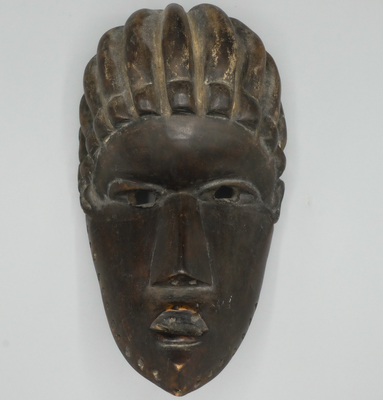
In Bassa societies, located primarily in modern-day Liberia, masks are often used in masquerades, both for rituals and performances. Bassa masks, like this one, are distinguished in part by how they are worn and attached to the rest of the masquerade ensemble: they are attached at an angle to a rattan basket-like frame that is worn over the head, so that the mask is on the forehead (National Museum of African Art). The dancer, or wearer of the masquerade ensemble, looks not through the eyes of the mask but through an opening in the cloth attached to the mask and basket frame.
In addition to its attachment style and size, which is noticeably smaller than that of an adult human’s face, the mask shares several other characteristics with other Bassa works. The coiffure, with its 10 vertical plaits, is carved into the mask rather than included as a separate part of the masquerade ensemble. This is relatively uncommon among masking traditions in the region (such as Dan or Mano) but typical of Bassa masks, which also generally include small ears. Though the style of the coiffure is recognizably feminine, the mask itself is understood as neither feminine nor masculine. Instead, when activated through masquerade, along with the rest of the attire, it is Gela, a specific force or spirit connected to the community (North Carolina Museum of Art no. G.74.22.4). This mask, and other Bassa Gela masks, are also recognized by the pointed chin and pronounced concave curve beginning at the eyes.
While this particular mask is unadorned, Bassa masks typically have accessories and are part of a larger ensemble when in use. The numerous holes around the edges of the mask, particularly the three large openings at the top of the coiffure, would be used to attach the mask to the rattan frame. The upper lip also has two holes, allowing for the insertion of teeth, typically those belonging to a domestic animal, such as a cow, into the mouth (National Museum of African Art no. 88-5-1). White chalk or pigment lines are frequently applied to Bassa masks to emphasize the eyes, nose, mouth, and coiffure (Detroit Institute of Arts no. 1996.267). On this mask, very faint lines of white/yellow pigment or chalk remain in the grooves of the coiffure and around the eyes. Without additional context, it is difficult to know whether this mask has ever been used in a masquerade context or if it was created for the Western art market.
Works Cited
Meneghini, Mario. “The Bassa Mask.” African Arts 6, no. 1 (1972): 44-48, 88. https://doi.org/10.2307/3334641.
Siegmann, William and Cynthia Schmidt. Rock of the Ancestors, ŋamôa kɔni: Liberian Art and Material Culture from the Collections of the Africana Museum. Cuttington University College, 1977, [vi], 1-34.
Mercer Thomas ('27) (Fall 2026)
Purchase Receipt and Supporting Documents
2020.10c.jpg (4504 kB)
Alternate view
2020.10e.jpg (5421 kB)
Alternate view
Keywords
David P. Harris Collection, African, West African, Mildred and Joseph von Barghahn, After 1800, Mask