

Preview
Creation Date
20th century
Geography
Liberia
Culture
Bassa
Medium
Wood, pigment, camwood powder
Dimensions
3 5/16 x 1 9/16 x 1 6/16 in. ( 8.4 x 4 x 3.5 cm)
0.907 oz. (25.7 g)
Credit Line
Bequest of David P. Harris ('46), 2020
Accession Number
2020.12
Provenance
Purchased by David P. Harris ('46) from Endicott-Guthaim Gallery in New York on March 5, 1976.
Condition
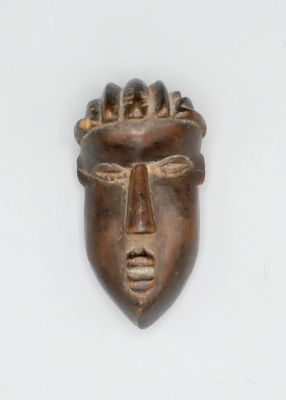
Overall, this mask is in excellent condition. On the tip of the nose, lips, cheeks, ears, and the front of the coiffure, there is a very faint patina as the wood lightens to a barely perceptible deep red. Traces of a white chalky pigment have been applied to the lips and in the grooves of the coiffure, which, along with the corners of the eyes, also has remnants of a red pigment, likely camwood powder. On the right side of the coiffure, the end of the stylized plait protruding from the forehead is slightly chipped. On the reverse of the convex mask, many vertical scratches reveal untreated wood. In addition to these scratches, there are small thin facets left behind from the carving process.
References
Brad Hostetler, with Ani Parnagian, "From Private to Public: The Collection of David P. Harris," in Ethiopian Objects in the Blick-Harris Study Collection: Art, Context, and the Persistence of Form, eds. Brad Hostetler, and Lynn Jones, Peregrinations: Journal of Medieval Art & Architecture 8, no. 1 (Spring 2022): 5–25. https://digital.kenyon.edu/perejournal/vol8/iss1/1/
Description
In several West African communities, miniature masks or Ma Go (literally ‘small head’) are used for personal, familial, and spiritual purposes. Bassa artists made this mask, but miniature masks are also common in Dan, Loma, and Mano communities, among others. Even with their minute scale—this example is just over three inches tall and an inch and a half wide—these masks are detailed and highly stylized. Like their larger counterparts, they sometimes have distinct cultural and spiritual types and meanings. Typically, these small masks are made for personal use and function as portable objects of protection and connection. Miniature masks may be made in the form of a particular full-sized mask whose spirit holds significance for the family or person who owns the miniature, a physical tether to that spirit and one’s ancestors.
Just as with larger masks, miniatures have distinct combinations of features that identify them as belonging to a particular community. This mask’s sharply sloped chin, which ends in a point, is a feature common to Bassa masks. Another is the coiffure. This miniature’s coiffure consists of three large central vertical plaits with three smaller, angled plaits on each side. The inclusion of plaits in the mask is relatively uncommon among masking communities in the region. According to scholars, other communities’ full-size masks are often without a coiffure because the mask’s hairline is generally covered by another part of the full ensemble during masquerades. However, this is not the case in Bassa masquerades (National Museum of African Art). These characteristic inclusions and exclusions carry over to their smaller counterparts.
The specific purpose and uses of miniature masks vary between communities and from mask to mask. Most often, miniatures are based on a corresponding mask and are connected to the associated spirit. According to some scholars, in Dan and Mano communities, miniature masks are usually only possessed by the wearer of a corresponding full-sized mask. In others, such as the Bassa community, anyone may have a miniature mask. Other scholars disagree, explaining that in Dan and Mano communities, anyone who has a connection to a mask may have a miniature.
Bassa communities typically have two types of miniature masks. In addition to the miniatures made of full-sized masks (Ma Go), they also have personal miniatures that are instead stylized portraits of their owners. Visually, these two types are very similar. More context about the piece is thus needed to differentiate which type a miniature is.
Constant handling and use, as well as the oils sometimes applied, often give miniatures a patina in places, making sections appear lighter or almost translucent (Met Museum no. 1979.206.311). This one has an almost imperceptibly faint patina on the tip of the nose, the lips, cheeks, ears, and the coiffure’s front.
Historically, African miniature masks have frequently been termed “passport masks” in Western art circles because of a misinformed belief that miniature masks functioned primarily as a means of identification. While miniature masks are sometimes used in ritual practices and carried with a person when traveling, identification is not generally one of their main functions. Works Cited
Meneghini, Mario. “The Bassa Mask.” African Arts 6, no. 1 (1972): 44-48, 88. https://doi.org/10.2307/3334641.
Siegmann, William and Cynthia Schmidt. Rock of the Ancestors, ŋamôa kɔni: Liberian Art and Material Culture from the Collections of the Africana Museum. Cuttington University College, 1977, [vi], 1-34.
Mercer Thomas ('27) (Fall 2026)
Purchase Receipt and Supporting Documents
2020.12b.jpg (1131 kB)
Alternate view
Keywords
David P. Harris Collection, African, West African, Endicott-Guthaim Gallery, After 1800, Mask