

One of the more pernicious and misunderstood canards attributed to Jews during the Holocaust by both Jews and non-Jews alike refers to their alleged passivity: that Jews went to their deaths passively accepting their fate “like lambs to the slaughter.” Is there any truth at all to the charge and were Jews responsible for their own suffering inasmuch as they walked silently to their own deaths? Or has this become an all too simplistic myth considering what researchers now know? As well were there individual and collective acts of resistance during the Holocaust?
The attribution perhaps assumes that Jews were not only apprised of their fate in advance, but that there were historical models that could have resulted in better preparation for their journey to death camps, or to forests where they would be stripped of their clothing and shot naked over pits or ravines. Where in world history were entire families rounded up, put on trains, transported to death camps to be gassed? Some Jews had been able to escape from the horror of a death camp and been able to brief their co-religionists on what they could expect if deported. Of course, the escapee would have to be believable, and that was not likely. Short of witness reports, where would the uninitiated Jews get information to act upon? Jewish victims were led to believe that they were being “resettled,” or possibly moved to labor camps. They were of course intentionally deceived. They wouldn’t know or be prepared for the death camps until it was already too late. What kind of preparation could they make? Efforts to escape or attack guards would mean summary execution of the guilty party’s family, so the Nazis took great care to conceal their ultimate intentions. Jews arrived at death camps after long rides in cattle cars with nothing to eat or drink - in the cold of winter or heat of summer - some forced to stand the entire trip in the train due to lack of space. Arriving to the sound of shrieking guards ordering victims old and young to get out of the cars - “schnell, schnell!!” - terrified of the menacing, drooling dogs held on the leash ready to pounce on the hapless Jews. Prisoners in striped uniforms collecting suitcases and whatever worldly possessions the newly arrived tried to cling to, but as well removing the bodies of the dead from the train cars.
This deliberately manufactured chaos was meant to terrorize the victims, augmenting their confusion, serving to preclude thinking itself, preventing the hapless passengers from getting their bearings in a futile effort to process the panic, as well as to prevent communication with family and friends, reducing the victims to the complete mercy of their Nazi captors. Then the lineup for the selection: left for the gas chamber, right for forced labor. Next the undressing room in preparation for the “showers,” the introduction of the Zyklon B canister. Those selected for forced labor are walked disconsolately in another direction . . .
An article appearing in the New York Times in May 1970, written by Israel Shanker based on an interview with Yehuda Bauer, at the time the head of Holocaust studies at Hebrew University in Israel, addresses the matter of “Europe’s Jews going to the slaughter.” Dr. Bauer emphatically states, “Europe’s Jews went to the slaughter, but not like sheep . . . they went because they often had no alternative. They went in families; they tried to protect and encourage each other.” He cites what his predecessor at the Hebrew University called “the dignity of the destroyed.” Dr. Bauer also reports that there was a Jewish resistance as well as attempts to escape despite threats by hostile communities. He refers to a woman who escaped from a mass murder near Vilna and went to warn the ghetto population who refused to believe her. “To be believed others who escaped had to tell the same story." Abba Kovner, the Israeli poet and founder of the Brichah movement that brought 300,000 Jewish Holocaust survivors to Israel - only 22 years old at the time - came from hiding to enter the Vilna ghetto (Lithuania) and wrote the first Jewish call to arms: December 12, 1941. Dr. Bauer spoke of the rebellions in four German death camps: Auschwitz, Treblinka, Sobibor and Plaszow: “They were not all successful, many prisoners escaped into forests but were caught later.”
It has seemed easier to understand the plight of the European Jews through the lens of passivity than to understand the enormous constraints that operated on Jews, and how limited their lives were in captivity, including how little they knew about their fate from day to day. Deception, not being informed about their true destination, promoted compliance and prevented uprisings. Nearly 500,000 Jews were held captive inside the Warsaw Ghetto by the summer of 1942 under appalling conditions: starvation, crowded rooms in rundown buildings; fear of Nazi guards as well as Jewish police, the latter completely subservient to the Nazis; dead bodies lying in the street to be disposed of, the stench everywhere; random murders by Nazis for no apparent reason. Over the years, periodic roundups to “labor camps” to thin the population. It would be discovered in winter of 1943 that the deportations were in fact to the death camp Treblinka where the Polish Jews of Warsaw were murdered in gas chambers. At this point, Jewish resistance forces in the Warsaw ghetto refused to allow the Germans to deport any more Jews. There were just 700 Jews left in the ghetto: teenagers, young men and women, outgunned and outnumbered, with little to eat, some smuggled guns, some grenades and homemade Molotov cocktails. They were led by 24-year-old Mordechai Anielewicz, who was inspired by the Jewish heroes of legend, men like Bar Kochba, Judah Maccabee, and the Zealots of Masada who chose death with dignity over surrender to the Romans.
Anielewicz knew full well they could not stop Nazi genocide, yet his Jewish Fighting Organization (ZOB) held off the better-equipped Nazis under Jurgen Stroop for 27 days, killing as many as 50 men in four days. Stunned, Stroop and his men were able to exit the ghetto, bring in more sophisticated weaponry, as well as SS and Wehrmacht men supplied by Himmler. They burned every building in the ghetto to the ground with flame throwers. More than 7,000 Jews were killed or took their own lives, including Mordechai Anielewitz. Those ghetto fighters who were captured were deported to concentration camps and killing centers, though some had been able to escape through the sewers with the help of another leader: Antek Zuckerman.
Proud of his work, Stroop sent a copy of his book with photographs - The Jewish Quarter of Warsaw Is No More! - to Heinrich Himmler.
The Warsaw Ghetto Uprising inspired armed uprisings in other major ghettos - Bialistock, Vilna, Bedzin, Czestochowa, for example - and in smaller ones like Lachwa. The death camps Sobibor, Auschwitz and Treblinka experienced rebellions as well. Many Jews escaped to forests and fought with partisan units such as the Bielski brothers, but as well with other partisans - Russians - that fought the Nazis. At
--Michael D. Bulmash, K1966
Browse the Bulmash Family Holocaust Collection.





-
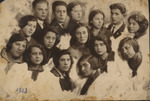
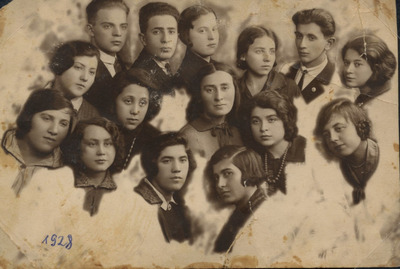
Warsaw, Poland Group Photograph
2014.1.413
Front: Group photo. Appears to be a compilation of several different photos. Verso: Handwriting in blue and black; '1928'.
-
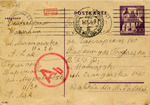
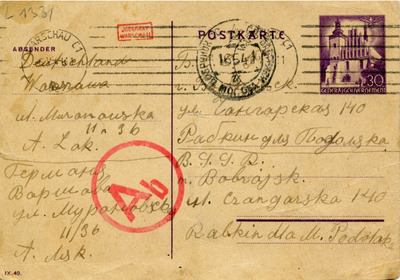
Postcard from Warsaw Ghetto to the USSR
2012.1.514
Postcard with message written in Polish. Includes purple printed postcard lines.
Information Provided by Michael D. Bulmash:
A postcard from the Warsaw Ghetto addressed to Bobrojsk, USSR. A 30GR General Government postcard from mother named A. Zak to her children; written in Polish and has boxed red 'Judenrat Warschau' Jewish censor mark at upper left. Translation: "Dear children your packages, letters & cards received here, thanks.... We try to reply weekly, hope you are receiving our mail... Please write often, you are our sole source for news... We are well, but could be better... We have just met Mania, Avram & Josek, also saw grandmother, she is here, and well, do try to send us some tea... I still have hope, kisses to you all..." The card was delayed by censor and cancelled Warschau 6.V.41; Nazi circular censor H/S at front; Russian receiving CDS 16.5.42 also at front. Six weeks later, the Nazis invaded the USSR.
-
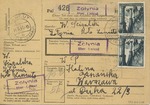
Receipt for Undelivered Package from Zolynia/Lancut to Dzika Street in Warsaw Ghetto
2019.2.85
Front includes one gray and three green postage stamps of architecture. Back includes two gray postage stamps of architecture, and "Zolynia" stamped three times in purple ink.
Information Provided by Michael D. Bulmash: The package in question arrived in the Warsaw Ghetto but was not delivered. Emanuel Ringelblum’s journal of life in the Warsaw Ghetto records that at the time this package was sent, the Ghetto post office was forbidden to handle foreign mail as well as food packages. Eventually, according to Ringelblum, all mail from outside of the Warsaw Ghetto was forbidden under the pretext of the danger of epidemics. The Nazis believed that Jews were especially susceptible to typhus, which presumably justified confining them to ghettos. Jews, in other words, were not only criminals in the eyes of the Nazis, but they were diseased as well. What commences for the Nazis as an ideology becomes a self-fulfilling prophecy: the conditions created by ghettoizing Jews – typhus, tuberculosis, and starvation (the official daily calorie count for Jews in 1941 was 184) – justify the need to continue to contain the Jews in ghettos. Of course, the ghettos were always a temporary measure, a place to quarter Jews until they could be transported to concentration and forced labor camps.
-
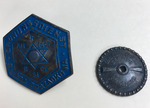
Częstochowa Ghetto Policeman's Badge
2019.2.75ab
Front [a] and back [b] piece of badge. Front of badge is hexagon shape and includes blue Star Of David and border with text around border. Round back piece screws onto front hexagonal piece of badge.
Information Provided by Michael D. Bulmash:
Badge manufactured in Warsaw (maker’s mark “J. Olszewski GRAWER WARSZAWA”) worn by members of the Jewish Service Police working in the Częstochowa Ghetto (signified by the inscription Alt R Tsch above the Star of David). The Jewish Service Police were auxiliary police units organized in the Jewish ghettos by local Judenrat councils under ultimate command of the occupying Germans. These auxiliary policemen were conspicuous by their armbands, hats, and badges, but were allowed no firearms, and were used primarily to secure Jews - utilizing their batons - for deportation or to guard food stores. Warsaw ghetto had the largest contingent of these policemen - as many as 2,500. They were both feared and detested by other ghetto residents for their willingness to exploit their charges for personal gain; for example, exchanging food for sexual favors. If they harbored any belief that they were different from other ghetto residents, however, the Nazis were to disabuse them of this illusion: they ultimately shared the same fate as the other ghetto victims.
-
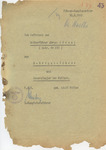
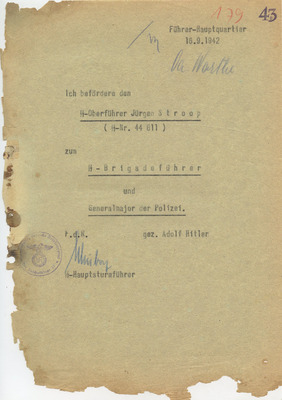
Document Relating to Jurgen Stroop and Rudolf Brandt
2019.2.20
Green paper, wear along edges, three underlined lines in center, "43" stamped in blue ink in top right corner.
Information Provided by Michael D. Bulmash:
Document from September 16, 1942 announcing Stroop’s promotion to the rank of the SS-Brigadefuhrer and Major-General of Police, the rank which he held at the time of the Warsaw Ghetto uprising, signed by an unknown Hauptsturmfuhrer. Stroop was the SS Police Leader of Warsaw who was responsible for the savage crushing of the Warsaw Ghetto Uprising in 1943 about which he wrote a book – intended as a souvenir for Himmler originally entitled “The Warsaw Ghetto is no more.” It took Stroop and his army a month of overwhelming firepower to subdue the Ghetto fighters who had little in the way of food or ordinance. Indeed, Stroop grudgingly acknowledged surprise at the fighting spirit of the ghetto inhabitants. Brought to trial as a war criminal, he was found guilty and executed – appropriately - in Warsaw.
[Related item: 2019.2.21]
-
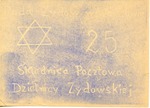
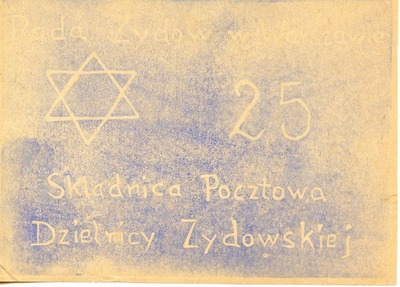
Warsaw Ghetto Scrip
2012.1.461a-d
Four pieces of scrip. Each are printed in blue on tan paper. Includes larger notes worth 25 and 50, and smaller notes worth 10 and 15. Each has designs that include a Star of David.
Information Provided by Michael D. Bulmash: Once they were deported to the ghettos or concentration camps, prisoners in some camps would be issued scrip (pieces of essentially useless pieces of paper that had no value outside the particular facility) by the Nazis in exchange for their confiscated valuable currency. Ghettos or camps could have their own distinctive scrip and coins, often with many different issues. Two sets of initials appear on the Warsaw Ghetto scrip: RZwW, which stands for Jewish Government in Warsaw, and SPDZ, which stands for the Jewish Postal Division. The notes are blue in color and crudely printed from hand-engraved wood or linoleum plates. The 25 groszy is somewhat different from the other denominations in that the names of the two organizations, Rada Zydow w Warszawie (RZwW) and Skladnica Pocztowa Dzielnicy Zydowskiej (SPDZ), are spelled out. The 50 groszy is the highest denomination and also the most symbolic. On the notes' right is a SS symbol in a flame of fire. In the center is a barbed wire fence separating the flame from 18 stars (Mogen David), symbolizing the incarcerated Jews, to the left of the note. In April 1943, the Warsaw ghetto revolted in reaction to the Nazi plan to "relocate" the remaining inhabitants to the death camp in Treblinka. The Jewish leadership was well aware of what awaited them as deportations to the killing centers had been ongoing for over a year. Armed resistance fighters engaged the German army in house to house fighting for a month. On May 16, 1943, SS Maj. Gen. Juergen Stroop reported that his forces were victorious and had completed the round-up of all remaining Jews. In reality, small pockets of the resistance fought on for several more months. However, the vast majority of the population of the Jewish Ghetto of Warsaw were sent to their deaths.
-
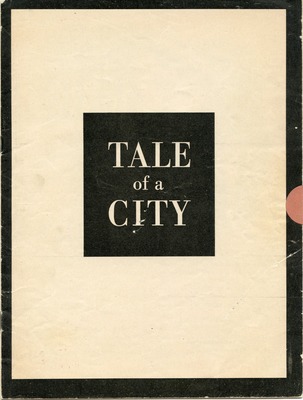
"A Tale of a City" Magazine About Warsaw
2012.1.539
Magazine with black square on cover. Titled, "Tale of a City." Includes information about Warsaw.
-
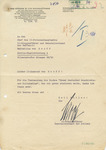
Letter from Jurgen Stroop
2012.1.385
Typewritten letter on "Der Höhere SS-Und Polizeiführer" stationery. Includes signature in black.
Information Provided by Michael D. Bulmash:
Stroop was the SS Police Leader of Warsaw who was responsible for the savage crushing of the Warsaw Ghetto uprising in 1943 about which he wrote a book - intended as a souvenir for Himmler - originally entitled “The Warsaw Ghetto is no more.” It took Stroop and his army a month of overwhelming firepower to subdue the ghetto fighters who had little in the way of food or ordnance. Indeed, Stroop grudgingly acknowledged surprise at the fighting spirit of the ghetto inhabitants. Brought to trial as a war criminal, he was found guilty and executed – appropriately - in Warsaw. Document on his "Der Hohere SS und Polizeifuhrer" letterhead. Sent to SS Gruppenfuhrer and Waffen SS Generalleutnant Maximilian von Herff in Berlin, thanking him for sending an edition of the "New German Cultural Atlas, which I would like to study..." Maximilian von Herff (1893-1945) commanded a corps in North Africa and later assisted Stroop in overseeing the liquidation of the Warsaw Ghetto.
-
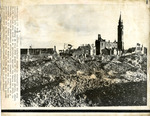
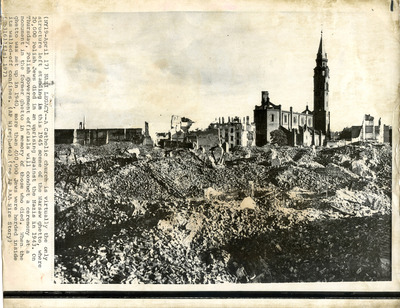
Ruins of Warsaw Ghetto: Wirephoto
2014.1.113
Front: A photo of a church standing amongst the ruins of a town. Includes typewritten information on the left side.Back: Several pasted newspaper clips.
Information Provided by Michael D. Bulmash:
AP Wirephoto of Catholic Church rising above the ashes of the former Warsaw ghetto. Catholic Church left standing in this 1945 photo of Warsaw ghetto where 20,000 Polish Jews lost their lives in uprising against Nazis in 1943. In 1940, more than 400,000 Jews had been herded inside its walled-off confines.
Verso: Thirty years later the Polish government conducted a ceremony to those who perished at a monument in the former ghetto.
-
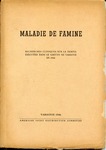
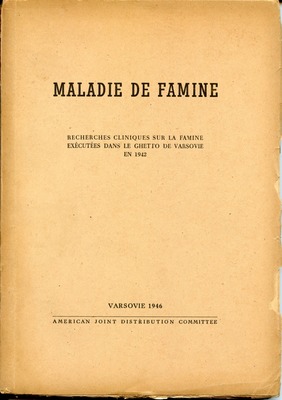
Maladie de Famine
2012.1.545
Book with tan cover with title, "Maladie de Famine: Recherches Cliniques sur la Famine Exécutées dans le Ghetto de Varsovie en 1942." Published by the American Joint Distribution Committee.
Information Provided by Michael D. Bulmash: Warsaw Ghetto Jewish physicians kept records of the effects of famine on patients admitted to the only hospital in the ghetto. This work, edited by Dr.Israel Maleikovski, who himself was deported to the death camps in 1943, was discovered among the ruins of the ghetto after the war.
-
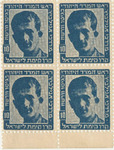
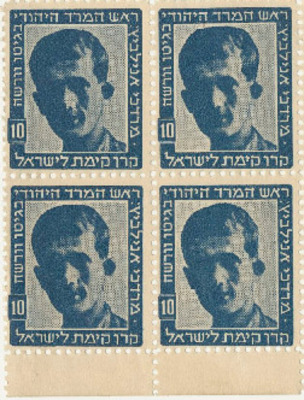
Provisional Label/Stamp Used During the Period Between British Mandate and Beginning of Jewish State
2021.1.73
Four dark blue stamps depicting a man, Mordechai Anielewicz. Hebrew text along all four borders.
Information Provided by Michael D. Bulmash:
Mordechai Anielewicz was founder and commander of the Jewish Combat Organization (ZOB) in the Warsaw Ghetto Uprising, who died at 24 fighting the Germans. A socialist-Zionist, he understood Germany’s intentions to liquidate the Jews of the Warsaw Ghetto and he refused to submit passively to their intentions. While political differences in the Ghetto led to fragmentation, Anielewicz was able to create an alliance of the many different groups in the Ghetto. They were able to secure weapons and ammunition, but it was hardly enough to stand up to the Germans. They nevertheless held them off for 30 days and refused to surrender. Fighting ended May 16 1943: 7000 Jews were murdered, the remainder sent to concentration camps. The Warsaw Uprising became an important symbol of Jewish armed resistance in the Holocaust.
-
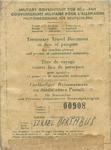
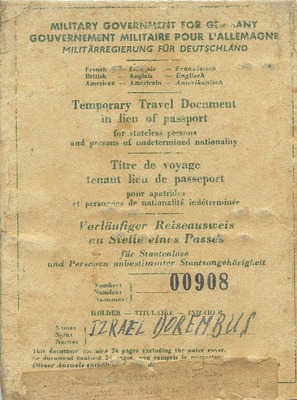
Post-WWII Temporary Travel Document in Lieu of Passport Issued by the Military Government of Germany to Israel and Helena Elbaum Dorembus
2019.2.244
Booklet with print and lines in green, “MILITARY GOVERNMENT FOR GERMANY” printed at top of cover, “IZRAEL DOREMBUS” written near bottom below “00908” printed in black ink, 25 pages. [Page 10-23 blank]
Information Provided by Michael D. Bulmash: Israel and Helena Elbaum Dorembus were originally from Poland. Helena is known for her diary, “Through Helpless Eyes: A Survivor’s Diary of the Warsaw Ghetto Uprising” about her life in hiding during the Holocaust. She had been sheltered by Polish Christians in Warsaw. She describes, for example, “…neighbors returning from town…tell(ing) of hundreds of dead Germans, wrecked tanks and wounded, frightened soldiers being taken to hospitals. Mrs. Zaleski seems to gloat as she praises the Jews for their heroism.” Dorembus describes a scene on the ‘Aryan’ side after the Germans had set the ghetto on fire. “A Jewish mother is seen leaping to her death from the third-story window of a burning building holding her little son. A Polish woman among the crowd cries out: ‘Jesus, Jesus, have mercy. After all, they are human beings.’ The woman covers her eyes with her hands.”
-
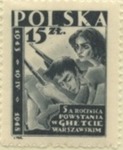
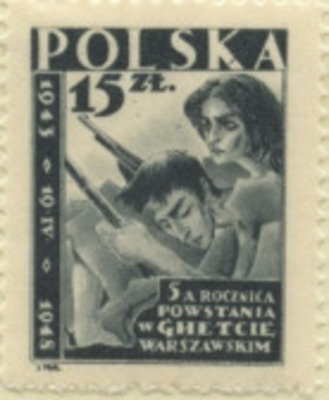
Warsaw Ghetto Uprising Commemorative Stamp
2012.1.423a
Stamp with an illustration of a man and woman holding guns. Titled, "Polska."
Information Provided by Michael D. Bulmash: Poland issued this stamp to commemorate the fifth anniversary of the Warsaw Ghetto Uprising on April 19, 1943.
-
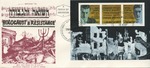
Holocaust and Resistance Commemorative Envelope
2012.1.407
White envelope. Left side is titled, "Holocaust & Resistance" in Hebrew and English and has a pink illustration of a "Destroyed Synagogue at Ghetto Warsaw." Right side has a large black stamp showing ruins.
Information Provided by Michael D. Bulmash: Envelope issued in Israel in 1983 on the 40th anniversary of the Warsaw Ghetto Uprising to commemorate Jewish resistance in the ghettos and the underground movements of occupied Europe. Pictured are Mordecai Anilewicz, one of the leaders of the Warsaw Uprising, and Yosef Glazman of Lithuania, organizer of the PPA in the Vilna Ghetto. The middle stamp reads "for the ghetto rebels, for the partisans in the forests, for the rebels in the camps, for the members of the underground, for the soldiers in the various armies."
-
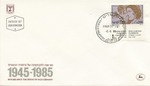
First Day Cover: Israeli Commemorating 40 Years since the defeat of Nazi Germany and Itzhak and Zivia (Lubetkin) Zuckerman
2012.1.137
White envelope with grey stamp showing two faces. Titled, "1945-1985: 40 Years Since the Defeat of Nazi Germany" in English and Hebrew.
Information Provided by Michael D. Bulmash: Israeli First Day Cover commemorating Itzhak and Zivia (Lubetkin) Zuckerman, heroes and survivors of the Warsaw Ghetto.
-
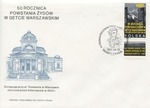
50th Anniversary of the Warsaw Ghetto Uprising Envelope
2012.1.436
White envelope with blue illustration of a synagogue. Titled, "50 Rocznica Powstania Żydów w Getcie Warszawskim."
Information Provided by Michael D. Bulmash: Poland first day release envelope from the 50th anniversary of Warsaw Ghetto Uprising.
-
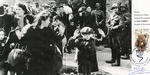
Photo Card of Iconic Image of Captured Residents of Warsaw Ghetto with Commemorative Stamp
2016.1.53
Image: Men, women and children with their hands raised while armed, uniformed men look on; Text at right “Special Presentation Folder, designed & autographed by IGAL GABAY, designer of stamp”, 95/180.
Information Provided by Michael D. Bulmash: Iconic photo of captured residents of the Warsaw Ghetto on a card along with Israeli stamp from 2003 commemorating 50th anniversary of Yad Vashem in memory of the victims of the Holocaust, and the heroism of the ghetto warriors who resisted the Nazis. Signed by stamp designer, Igal Gabay.
-
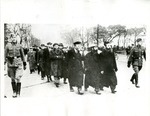
Jewish Terror in Warsaw
2014.1.110
Front: A black and white photograph of Jewish men in heavy jackets being escorted by the military.Back: Several hand stamps and various writing. Includes source as International New Photo
Information Provided by Michael D. Bulmash: News wire photo of Jews in Warsaw Ghetto. Verso: "Jewish terror in Warsaw" and "Jews in Warsaw" with a date stamp of November 7, 1941. The Warsaw Ghetto had been the largest ghetto in occupied Poland in the General Government with more than 400,000 residents. While there is no further information on this photo, these men are possibly being marched to a work camp. Deportations to Treblinka began in November of the following year.
-
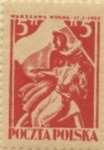
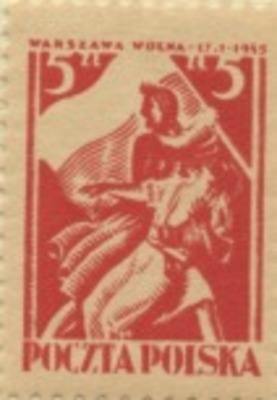
Polish Stamp Commemorating the Liberation of Warsaw
2012.1.420b
Stamp with red illustration of a man holding a flag and a woman. Titled, "Poczta Polska."
Information Provided by Michael D. Bulmash: Polish stamp commemorating the liberation of Warsaw in 1945.