

Preview
Creation Year
January 1967
Image ID
AQ.060
Alternate Identifier
B42.060
Subcollection
AQ: Konya Region of Turkey
Abstract
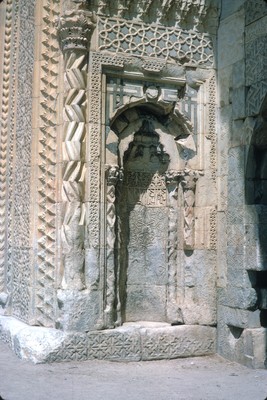
A closer look at the inner walls of the pishtaq. The tracery depicts a combination of geometrical elements with a natural influence. Patterned brickwork, arabesques, braids, syrian knots, and arabic inscription are carved into the limestone. - CK
Description
Sultan Han was built in 1229 along the Uzun Yolu (Long Road) trade route linking Konya and Aksaray and extending to Persia. The caravanserai is highly fortified and was built to equip traders, wealthy men, doctors, and their animals and cargo. For a full -CK
References
Stierlin, Henri, and Anne Stierlin. "Turkey, from the Selçuks to the Ottomans." Köln: Taschen, 1998. Print.
"Sultan Han." Wikipedia. Wikimedia Foundation, n.d. Web. 07 Sept. 2016.
Image Notes
Creation date unknown. Photograph processed September 1967. Formerly catalogued as B42.060. Notes written on the slide or index: Sultanhanı.
Image Format
35 mm slide
Geographic Reference
Sultanhanı, Turkey
Keywords
Thirteenth Century, Seljuk, Caravanserai, Stone, Masonry, Stone Carving, Girih, Columns, Engaged Columns, Corinthian Capitals, Column Capital, Arabesque, Inscription, Arabic Inscription
Rights Statement
