

Preview
Geography
Japan
Culture
Japanese
Medium
Ivory
Credit Line
Bequest of David P. Harris ('46), 2020
Accession Number
2020.252
Description
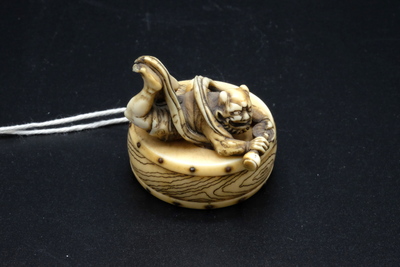
"The Netsuke of Raijin depicts the god of thunder lying on his stomach, with his bare feet raised aimlessly in the air behind him. A cloth wraps around his body, winding around his neck, beneath his muscular arms, and up to his feet. He rests atop a drum, much larger than himself. His key iconography is present here, since he is commonly associated with drums; on the bottom of the drum a tomoe symbol can be seen, a symbol common in Shinto artwork. Its form comes from a piece of armor called the tomo, an elbow guard to protect from arrows. It was thus a protective symbol, as its swirling form evoked images of water and so was considered protection from fire. This symbol is quite common and is often present on Raijin’s drums. The god of thunder is identifiable by his physical features as well– he is shown most often as fearsome and strong, with characteristics resembling those of an oni, such as a pair of horns, which are present here.
[...]
The sculpture is made entirely of ivory, and is only about 1.3 inches tall, and 1.3 inches wide all around. This aligns with the functionality of netsuke, as they were most often small and meant to be carried around. Raijin’s physical features are meticulously sculpted despite the small size. A large hole is present through the base of the drum which partly accounts for the cord, which would require a place to attach. It also perhaps could be a way to lighten the netsuke, as that would be preferable for an item which would be carried often. The result is a compact, smooth, light, and graceful sculpture which is ostensibly made entirely of ivory, an expensive material, and this aligns as expected with the functionality of netsuke. Regardless of its size a netsuke worked best if it was not fragile, and they needed to be relatively compact with minimal easily snapped parts. If there were fragile parts, they were recessed. The person carrying the Netsuke of Raijin would thus be able to show off their refinement and wealth to anyone who noticed, without sacrificing the functionality of the netsuke."
~ Excerpt of a final paper for ARHS 114 Introduction to Asian Art (SP 2024), written by Elliot Kennedy
Keywords
David P. Harris Collection, Asian, East Asian, Japanese