

Creator Biography
Butterfield and Brothers Company, American.
Preview
Creation Date
ca. 1905
Geography
United States
Culture
American
Medium
Bronze
Dimensions
Medal–
Diameter: 2.5 in. (6.3cm)
Width: 0.2 in. (0.6 cm)
Weight: 4.8 oz (135.2 g)
Box–
Dimensions: 3.9 × 3.8 × 0.5 in. (9.9 × 9.7 × 1.4 cm)
Weight: 1.2 oz (32.9 g)
Credit Line
Gift in Loving Memory of Boris Blick & Judith Rosenbloom Blick by their daughter Sarah Blick, 2024
Accession Number
2015.161
Condition
The medal is in relatively good condition, with the exception of what appears to be plaster buildup in the crevices of the letters on the obverse and the details of the reverse.
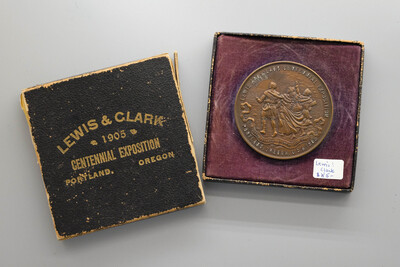
The medal’s box is in much worse condition, with lots of fraying of the cardboard mainly around the edges of the lid, as well as around the corners of the bottom of the box. Additionally, the box lid is missing its left panel and part of the right panel. Besides the area in which the medal would be placed, the velvet inside of the box is discolored. (March 2025)
Signatures, Inscriptions, and Markings
Obverse:
LEWIS AND CLARK CENTENNIAL EXPOSITION.
WESTWARD THE COURSE OF EMPIRE TAKES ITS WAY
W. KLUMPP ENG.
PORTLAND, OREGON, U.S.A. 1905
Reverse:
BUTTERFIELD BROS.
Box:
LEWIS & CLARK
1905
CENTENNIAL EXPOSITION
PORTLAND. OREGON
Handwritten Sales Sticker:
Lewis &
Clark
$85–
Description
This small medal was made by the Butterfield and Brothers Company to celebrate the 100-year anniversary of Lewis and Clark’s expedition from Missouri to the Pacific Coast. Engraved on the banner of this object it states “Westward the Course of Empire Takes Its Way,” revealing the intention behind the Lewis and Clark expedition as well as the intention behind the creation of this object. The Lewis and Clark expedition proved to a point of national pride, for the successful expedition seemed to prove America’s might despite its young age. This expedition was also part of the larger 19th century push toward Western expansion widely labeled as “Manifest Destiny.” Manifest Destiny was the belief that America was destined to expand westward and that they were owed the land in the West. This idea was perpetuated throughout many forms of media and propaganda, with media widely disseminating the idea that Americans were owed this Western land and should therefore expand using any means necessary. Lewis and Clark’s expedition was the first time much of the West was explored by Americans, and the expedition and their writings served as one of the first accounts of this previously undiscovered land. It was accounts such as this that were used in propaganda that further perpetuated the arguments of Manifest Destiny, leading to the wars that acquired Texas from Mexico and Oregon and Washington from Canada. To garner popular support for such movements, accounts from expeditions like Lewis and Clark’s were essential, as they showed the wonders, beauty, and unknowns of the “Wild West.” The commemorative medal re-emphasizes this idea one hundred years later, particularly in this engraving, as it purports America’s status as a great empire. This speaks to the purpose and power of commemoration in forms such as this, as commemorations have the ability to continue cultural narratives long past their origins. Commemorations have the power to rewrite the past in our modern consciousness, showing the constructed nature of history. Although commemorations are intended to accurately preserve and pass on the memory of individuals and events, this commemoration proves to not only be useful in terms of memory, but it also proves to be useful in reinforcing certain cultural narratives and understandings of history. Objects like this then beg the question - is all cultural memory mediated through various perspectives or can memory be “accurately” and objectively preserved through objects?
Bailey Luke ('17)
The obverse of this commemorative medal displays an image of Meriwether Lewis, Sacagawea, and William Clark standing with their backs facing the viewer looking out and waving as the sun sets over the Pacific Ocean. Sacagawea wears long draped clothes and a cloak with stars around her shoulders as she places her arms around Lewis and Clark. Lewis and Clark are shown holding items such as rifles and an ax. Below the scene is a floating banner that reads, “Westward the course of empire takes its way.” Just under this reads the engraver’s name, W. Klumpp. Inscribed around the top edge of the medal, it reads: “Lewis and Clark Centennial Exposition”. The bottom of the medal reads “Portland, Oregon, U.S.A, 1905.”
Around the edge of the reverse is a wreath made of leaves and berries with a ribbon tying it at the center of the bottom. Just below this, the company who created the medal, Butterfield Brothers, is named.
The box is made of cardboard covered in a black material, perhaps bonded leather, and in stamped gold letters it reads, “Lewis & Clark”, with the Centennial Exposition’s location and date: Portland, Oregon, 1905. The inside of the box includes a purple fitted velvet pad for the medal to be placed on. Though not a part of the original design, there is a price sticker on the velvet’s bottom right corner reading, “Lewis & Clark”, with the price of $85.
Keywords
Boris A. Blick Collection, American, After 1800, Medal