

Creator Biography
PORTFOLIO COLLECTION:
Jamake Highwater (introductory essay author)
Dr. Hartley Burr Alexander (introductory essay author, 1932 edition)
Land O'Sun Printers, Scottsdale, Arizona (printers)
Roswell Bookbinding, Phoenix Arizona (portfolio cases)
Bell Editions, Santa Fe, New Mexico (1979 publisher)
C. Szwedzicki, Rue de France, France (1932 publisher)
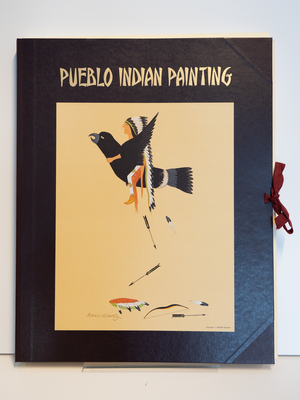
COVER ART (Montezuma mounting into the heavens on his eagle):
Richard Martinez, San Ildefonso Pueblo, 1904–1987 (artist)
Preview
Creation Date
1932 (reproduction), 1979 (facsimile of reproduction)
Geography
America
Culture
Native American, San Ildefonso Pueblo
Medium
Six-color offset lithography on Rising Art Print paper
Dimensions
20 × 15 15/16 in. (50.8 × 40.48 cm)
Credit Line
Purchase by the Department of Art History, 2025
Accession Number
2025.113
Signatures, Inscriptions, and Markings
50 Reproductions of Watercolor Paintings by Indian Artists of the New Mexican Pueblos of San Ildefonso and Sia
Description
This portfolio is a collection of 50 reproduction prints of paintings by Julian Martinez, Encarnacion Peña, Abel Sanchez, Romando Vigil, Louis Gonzales, Richard Martinez, Awa Tsireh, Miguel Martinez, and Velino Herrera. All nine artists included in this collection are members of the San Ildefonso and Zia Tribes. This folio is a 1979 facsimile of the original 1932 edition. 750 numbered and signed copies of the 1979 edition were produced. This copy is number 110 of 750, and is signed by Jamake Highwater. The collection is accompanied by two introductory essays: “Rediscovering America Through Indian Art Part II: The Pueblo Renaissance” by Jamake Highwater and “Introduction to the 1932 Edition” by Hartley Burr Alexander.
According to Alexander’s essay, the collection, with the exception of three paintings by Velino Herrera, “was brought together by Miss Anne Evans of Denver (1871–1941)” (19). Anne Evans donated her collection of Native American and Spanish Colonial folk art to the Denver Art Museum. Evans was the daughter of John Evans (1814 –1897), a territorial governor of Colorado who was forced to resign for his role in the Sand Creek Massacre, which resulted in the death of hundreds of Tsitsistas/Suhtai (Cheyenne) and Inunaina (Arapaho) people.
In 1929, Dr. Oscar B. Jacobson, the head of the art department of the University of Oklahoma, commissioned the French printer C. Szwedzicki to reproduce a folio of thirty paintings called Kiowa Indian Art, based on exhibitions he curated in Denver and Prague. In 1932, Jacobson commissioned this folio, Pueblo Indian Painting. Highwater’s essay notes that “the fifty color plates of the [1932] folio were produced with the utmost care and taste, the plates hand colored on a photomechanical key, in an edition limited to no more than 500 copies” (10).
Individual Digital Kenyon entries for the prints within this collection can be found at the following links:
(2025.113.1-2025.113.50)
Male figures in the costume of the Hunter in the Buffalo Dance
Female figure in the costume of the Buffalo Dance, carrying Sun Disc
Procession of female figures representing women in the costume of the Basket Dance
Male and female figures from the Buffalo Dance
Highly conventionalized figures of type participants in the great Corn Dance
Prepresentation of the Basket Dance in its tableau moment
Turkey associated with maize plants and rain-cloud designs
Bird-forms associated with a plant-form composed of cloud and rain-emblems
Deer, with mountain terrace below and cloud emblem above
Deer (buck and doe) under cloud crescents and rain pendants
Representation of the Big Horn
Representation of the Buck in the Deer Dance
Ceremonial clowns, generally known under the the Keres Name Koshare
Symbol of the sun rising above the rain cloud, with skunks below
Female dancer in costume of the Butterfly Dance
Female dancer in costume of the Sun Dance
The great Corn Dance, showing choir and male and female dancers
Montezuma summoning the animals from their caverns
Highly conventionalized Avanyu, or Plumed Serpent, after the manner of the vase-painters
Circle of women dancers in Harvest Festival
The Snake Dance, with alter, as celebrated in the Hopi villages of Arizona
Gigantesque figure from the Shalako Dance of the Pueblo of Zuñi
Landscape showing deer with tree and rainy sky
Landscape showing bear in the mountains
Hunter's Dance, with rainy sky
The Eagle Dance, in which two dancers mime the soaring flight of eagles
Skunks surmounted by sky crescent with cloud terraces and by the symbol of the sun
Bear with body of a deer, surmounted by sky symbols
Antelope surmounted by sky symbols
Turkey, with mountain and cloud terraces and sun symbol
Snake Dance performer, wearing the kilt adorned with the emblem of the Feathered Snake
Symbolic bird made of cloud and rain signs with the head of an eagle surmounted by cloud terrace
"Thunder-bird" holding the Avanyu
The sun-disk rising from the body of the Avanyu shown with bird attributes
Antelopes running under rainy skies with the signs of the sun, the birds and implements of the chase
Introductory 2-3.jpg (6883 kB)
Introductory 4-5.jpg (5800 kB)
Introductory 6-7.jpg (7444 kB)
Introductory 8-9.jpg (8388 kB)
Introductory 10-11.jpg (7525 kB)
Introductory 12-13.jpg (6691 kB)
Introductory 14-15.jpg (8111 kB)
Introductory 16-17.jpg (8029 kB)
Introductory 18-19.jpg (8086 kB)
Introductory 20-21.jpg (7624 kB)
Introductory 22-23.jpg (7345 kB)
Introductory 24-25.jpg (7495 kB)
Introductory 26-27.jpg (7180 kB)
Introductory 28.jpg (6276 kB)
Keywords
After 1800, American, Native American, Pueblo