

Preview
Creation Date
830/1–842
Geography
Minted in Constantinople
Culture
Byzantine
Medium
Copper alloy
Dimensions
7.05 g
31 mm
Credit Line
Long-term Loan from Brad Hostetler, 2025
Accession Number
2025.7
Condition
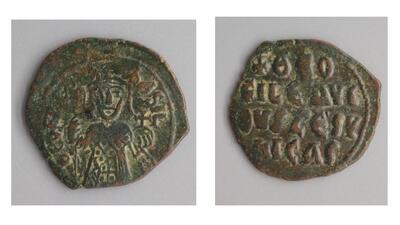
The rim and raised parts of the coin are brown, yet flat areas of the coin are mostly dark green, with lighter green near where the texture changes flat to raised. The edges of the coin are worn down in a rounded shape. A straight line and pointed area on the rim around the 3 o’clock position on the reverse shows where the coin was clamped. The coin is offstruck, meaning its blank was not placed exactly between the dies, metallic stamps containing the coin’s design. Because of this, the bottom right edge of the obverse and the left edge of the reverse are cut off. A couple of letters on the reverse are blundered, but otherwise the inscription remains clear. (December 2024)
References
Philip Grierson, Catalogue of the Byzantine Coins in the Dumbarton Oaks Collection and in the Whittemore Collection, vol. 3, Leo III to Nicephorus III, 717–1081 (Washington, DC: Dumbarton Oaks Research Library and Collection, 1973), 435–439 (DOC 15–16).
Description
This coin is from the reign of Theophilus, who ruled between 829 and 842. It was minted in Constantinople. This is a copper alloy coin, termed a follis. On the obverse, we see a frontal figure of Theophilus, wearing a toupha, a plumed fan-like headdress, and loros, a diamond-patterned imperial costume. He also holds two crosses, a labarum in his right hand, which references military themes and the first Christian Byzantine emperor, Constantine, and a globus cruciger in his left hand, symbolizing Byzantine power and Christian rule. The inscription curving around the figure reads “Theophilus, emperor.”
On the reverse we see a four-line inscription, “Theophilus Augustus, thou conquerest.” This inscription was a change by Theophilus away from a denomination marker M, which had recently lost value. Unlike previous coins, Theophilus’ folles did not have any indication of value, officina, or mint year.
Theophilus was the last ruler of the Late Antique/Early Byzantine empire, and second emperor of the Amorian Dynasty. Born circa 812/13, he was first crowned co-emperor with his father, Michael II, in 821 and then became sole emperor upon his father’s death in 829. Theophilus was the last and most resolute iconoclast, cracking down on iconophiles and icon makers. He issued ceremonial coins and a new follis type which had a multiple line inscription instead of the value “M” on the obverse side. Theophilus was also involved in multiple military campaigns against the Abbasids. Although Theophilus suffered many defeats to them, he did experience two victories against the enemy troops in 831 and 837, respectively.
Based on the military associations of the labarum and toupha seen on the coin’s obverse, the reference to conquest in the reverse inscription, and the Byzantine victory over the Abbasids in 831 (the year when this follis style was first minted), it is possible that the coin was meant to both commemorate the military victory and celebrate Byzantine dominance and power. In addition, the follis speaks to Theophilus and his fiscal policies. He instituted regional mints and headed urban renewal projects. Finally, the lack of religious figural representations can be attributed to Theophilus’ iconoclast position. Theophilus was the last iconoclast emperor, and he instituted severe punitive measures against iconophiles.
Merium Qureshi (Florida State University, ’28) for ARH 2020 Reading and Writing Art History (fall 2024), taught by Dr. Lynn Jones.
Obverse
2025.7_003.jpg (2349 kB)
Reverse
2025.7_diagram.jpeg (923 kB)
2025.7_diagram
Keywords
600–1800, Byzantine Art