

Preview
Creation Date
1994–1866 BCE
Geography
Southern Babylon
Culture
Babylonian
Medium
Incised clay
Dimensions
1 3/4 × 1 2/5 × 4/7 in. (4.5 × 3.4 × 1.5 cm)
1.15 oz. (32.7 g)
Credit Line
Gift in Loving Memory of Boris Blick & Judith Rosenbloom Blick by their daughter Sarah Blick, 2024
Accession Number
2020.491
Provenance
We do not know when and where Boris Blick purchased this tablet, but he acquired a total of three at some point in the late 1990s and early 2000s. One of these tablets was purchased from a mail order antiquities catalogue called the Worldwide Treasure Bureau and two from Akron-based art dealer by the name of Bruce Ferrini. Ferrini claimed that his tablets came from Afghanistan. While it is not impossible for his tablets to have originated in parts of Afghanistan, it is more likely that they originated from Iraq at some point and passed through an intermediary dealer in Afghanistan. The provenance is murky, and we can not define the millennia of time between the clay hardening and their appearance in the Blick-Harris Study Collection.
Signatures, Inscriptions, and Markings
Obverse:
7 ŠE GUR ŠU-LA2
KI nu-ur2-dKAB-TA
[…]
DUMU ra-ma-ti-[…]
ŠU BA-AN-TI
ITI SIG4-A
ŠE I3-AG2-E
Reverse:
[IGI] dSUEN-i-[…]
[…]
IGI dIŠKUR-lu-NUMUN
KIŠIB LU2-INIM-MA-BI-ME
ITI GAN-GAN-E3 UD […]
MU EN dUTU
BA-HUN-GA2
Translation
Obverse:
7 kors of barley as šu-lá (loan).
From Nūr-Kabta.
[…],
son of Ramati-[…],
he received it.
In the month Simānu,
he will pay back the barley.
Reverse:
[In front of] Sîn-i[…]
[…]
In front of Adad-lū-zērum
These are seals of witnesses
Month: Kislīmum, Day: […]
Year: the en-priestess of Šamaš
was installed
Translation by Dr. Gabriel Rabanal-Bolaños.
References
Franjola, Sacha L. and Brad Hostetler. "Mesopotamia in the Midwest: Cultural heritage law, ethical debates, and the cuneiform tablets in the Blick-Harris Study Collection." John W. Adams Summer Scholars Program in Socio-Legal Studies (2024). https://digital.kenyon.edu/summerlegalprogram/19
Description
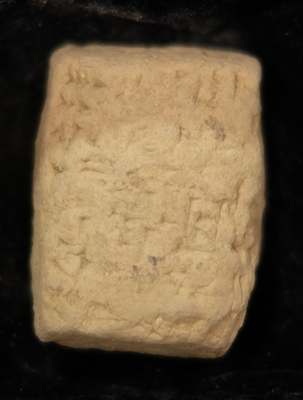
Written in Sumerian, using cuneiform, this tablet can be traced back to Southern Babylon. It comes from the Isin-Larsa period (2004–1763 BCE), the period marking the decline of the Ur III period (2112–2004 BCE) and before the Old Babylonian period (1894–1595 BCE). The impressed wedges describe a loan contract concerning commercial agreements of barley. It claims that Nūr-Kabta will pay back the barley loan within a few months. This is a standard text of the time as the primary function of tablets was the recording of transactions, loans, agreements, and other legal and agricultural business. We can trace back the tablet to Southern Babylon around 1994–1866 BCE, as the date is marked as the year “the en-prestess of Shamash was hired”, or late second millennium BCE. The recording of dates through kinship and changes within the monarchy was standard practice, and thankfully for our sake, common to include within these written accounts of exchange and labor.
Ellie Westfall (’27) for Summer Scholars 2025, with research by Dr. Gabriel Rabanal-Bolaños.
Obverse
2020.491_back.jpeg (4651 kB)
Reverse
2020.491_frontscale.jpeg (4469 kB)
Obverse - scale
2020.491_oblique.jpeg (3906 kB)
Oblique view
Keywords
Boris A. Blick Collection, Bruce Ferrini, Ancient Near East, Before 600 CE