

Preview
Creation Date
5500–3000 BCE
Geography
Northern Syria or Western Iran
Medium
Stone, serpentine
Dimensions
1 1/5 × 3/4 × 2/5 in. (2.7 × 1.9 × 1 cm)
0.44 oz. (12.5 g)
Credit Line
Bequest of David P. Harris ('46), 2020
Accession Number
2020.274
Provenance
While a receipt for this object was not cataloged in David P. Harris’s records, it is likely that this piece was purchased by Harris from Julia Schottlander (Tetragon) in London, based on the information from a receipt cataloged with another object. If this identification is correct, then this stone amulet is said to have been collected by a French diplomat in Baghdad in the 1950s.
Description
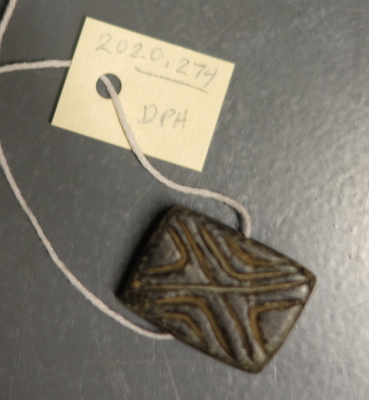
Both the obverse and reverse are carved with a similar geometric design. I propose that it was used as a seal stone, of the tabloid variety, and was worn not necessarily as an amulet, but as a tool of personal protection and administration. The string channel running horizontally indicates that this would have been strung on cordage, perhaps, but would have been too heavy to wear as a decorative bead on a larger piece of jewelry. It was not uncommon, rather normal practice, to wear your seal stone as a necklace for protection.
We do not know where Harris acquired this piece, but it is likely that he purchased it in the 1990s from Julia Schottlander of Tetragon, from whom he bought most of his ancient and Near Eastern objects. A receipt, catalogued by Harris with other pieces in his collection, lists a series of otherwise unknown — and an unclear number of — objects:
KA - 2nd Century AD
bronze head
Uruk - Djemdet Nasr £165
Uruk - Djemdet Nasr
stone amulet £320
I suggest that the “stone amulet” may refer to this stamp seal (see also object 2020.247 for another possible object that may be identified with this list). If correct, then we can see that Schottlander attributed this piece to the Uruk Jemdet Nasr period. Jemdet Nasr was a period in Sumerian history, but also a city-state in eastern Iraq that thrived from about 3100–2900 BCE. However, upon further research into similar pieces, I suggest that we can more accurately attribute this piece to Western Iran or Northern Syria in the fifth millennium BCE. Comparative stamp seals at the Los Angeles County Museum of Art have been attributed to this region and period and are made of dark phyllosilicates (i.e. serpentine and chlorite) that resemble the appearance of our stone. Such an attribution could also associate our piece with the Elamites, perhaps Susa. In the excavation reports of Robert J. Braidwood, he describes the first period (A) of the site of Amuk containing seal stones of many varieties, most notably the “gable” variety that is rectangular in form and consists of simple parallel crossing lines before Period B of Amuk refines the geometric crossing design into more elaborate and delicate line work. These tabloid seals date from about 5500–3000 BCE, while the Period A seals are from about 5500–5200 BCE. These seals are exclusively made from chlorite and serpentine at this time. Given the range of comparanda, this piece can be most accurately attributed to 5500–3000 BCE in Northern Syria or Western Iran, making this the oldest object in the Blick-Harris Study Collection. If datable to the fifth millennium, this seal would be one of the oldest held in an Ohio collection.
Comparative Pieces
Stamp Seal, gabled with rounded black, 3500–3100 BCE. LACMA, no. 76.174.518. https://collections.lacma.org/node/185504
Stamp Seal, tabloid, Western Iran, 4th Millenium BCE. LACMA, no. 76.174.530. https://collections.lacma.org/node/185699
Stamp Seal, Northern Syria, 6th–4th Millenium BCE. LACMA, no. 76.174. 450. https://collections.lacma.org/node/185200
Sources Consulted
Ancient Bronzes, Ceramics, and Seals: The Nasli M. Heeramaneck Collection of Ancient Near Eastern, Central Asiatic, and European Art. Los Angeles: Los Angeles County Museum of Art, 1981.
Ellie Westfall (’27) for Summer Scholars 2025
Purchase Receipt and Supporting Documents
2020.274_side1.jpg (3218 kB)
Side 1
2020.274_side2.jpg (3494 kB)
Side 2
2020.274_channel.jpeg (2719 kB)
Alternate view
2020.274_sideview.jpeg (2607 kB)
Alternate view
Keywords
David P. Harris Collection, Julia Schottlander (Tetragon), Asian, West Asian, Before 600 CE