

Preview
Creation Date
3100–2900 BCE
Geography
Uruk, Sumer, modern-day Iraq
Culture
Proto-Sumerian, Jemdet Nasr Period
Medium
Stone
Dimensions
1 × 1 1/4 × 4/7 in. (2.5 × 3.3 × 1.8 cm)
0.5 oz. (14.1 g)
Credit Line
Bequest of David P. Harris ('46), 2020
Accession Number
2020.247
Provenance
While a receipt for this object was not cataloged in David P. Harris’s records, it is likely that this piece was purchased by Harris from Julia Schottlander (Tetragon) in London on April 23, 1994, based on the information from a receipt cataloged with another object. If this identification is correct, then this stone amulet is said to have been collected by a French diplomat in Baghdad in the 1950s.
Description
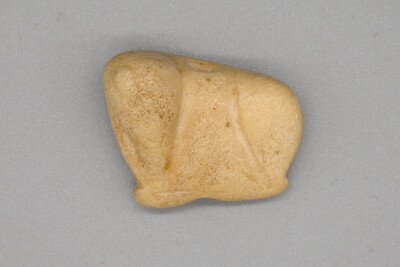
This cream-colored stone amulet comes from the Uruk in the Jemdet Nasr Period (also called the Uruk II period), approximately 3100–2900 BCE. The zoomorphic form can be interpreted as a recumbent animal, perhaps bovine or a calf, as these are common to amuletic imagery in this period. Amulets of this type were often worn as a form of protection and ornamentation. While this amulet maintains a smooth reverse, many amulets like this were engraved with signs, allowing it to also function as a seal for impressing clay. A channel runs vertically through this amulet where we can assume it was strung as jewelry or for safe-keeping.
Comparative Pieces
Stamp-Seal. Jemdet Nasr Period, 3000–2900 BCE. British Museum, no. 128811. https://www.britishmuseum.org/collection/object/W_1936-0613-207
Stamp-Seal. Jemdet Nasr Period, 3000-2900 BCE. British Museum, no. 118016. https://www.britishmuseum.org/collection/object/W_1926-1009-1
Seal amulet in the form of recumbent bovine. Late Uruk-Jemdet Nasr Period, 3300-2900 BCE. British Museum, no. 10.130.1186. https://www.metmuseum.org/art/collection/search/322439
Ellie Westfall (’27) for Summer Scholars 2025
Keywords
David P. Harris Collection, Julia Schottlander (Tetragon), Asian, West Asian, Before 600 CE