

Preview
Creation Date
20th century
Geography
Aksum, Ethiopia
Culture
Aksumite, Ethiopian, African
Medium
Stone (?)
Dimensions
Length: 4 3/4 in. (12.1 cm)
3.132 oz. (88.9 g)
Credit Line
Bequest of David P. Harris ('46), 2020
Accession Number
2020.230
Provenance
Purchased by David P. Harris from Maria Teresa O’Leary (Nuevo Mundo) in Alexandria, Virginia on February 28, 1976.
Condition
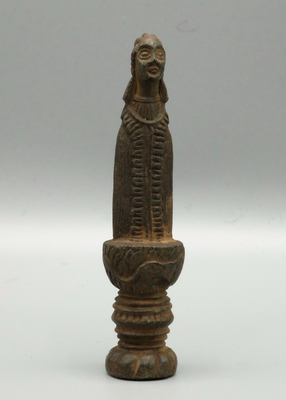
The stamp is in good condition. No significant damage is apparent in its figurative elements, as details of the woman’s face and hair are intact. A small circular puncture is present in the represented fabric of the stamp’s posterior. The cause of this mark is unknown and may date contemporaneously with the object’s creation or to a later period. Minor variations in color on the handle, particularly in the depicted fabric, indicate the stamp’s wear over time. The seal matrix is also well-preserved. Differing colors caused by wear are evident, but details of the figure’s face and flanking inscriptions remain mostly intact. (June 2025)
Signatures, Inscriptions, and Markings
Seal matrix:
1. An ancient South Arabian inscription is placed to the left side of the central portrait (when impressed):
- From bottom to top: ���� (N and G); remaining characters are illegible.
2. A Ge’ez inscription is placed to the right side of the central portrait (when impressed):
- From top to bottom: symbol of a cross; ሳባ (“Saba” or “Sheba”); symbol of a disk and crescent
Inscription translations are attributed to Mikael Muehlbauer, PhD.
References
Brad Hostetler, with Ani Parnagian, "From Private to Public: The Collection of David P. Harris," in Ethiopian Objects in the Blick-Harris Study Collection: Art, Context, and the Persistence of Form, eds. Brad Hostetler, and Lynn Jones, Peregrinations: Journal of Medieval Art & Architecture 8, no. 1 (Spring 2022): 5–25. https://digital.kenyon.edu/perejournal/vol8/iss1/1/
Quentin Clark, "Medieval Aksum and the Queen of Sheba: The Iconography of a Twentieth-Century Ethiopian Seal Stamp," Kenyon VRC Blog, July 3, 2025. https://vrc.kenyon.edu/blog/medieval-aksum-and-the-queen-of-sheba-the-iconography-of-a-twentieth-century-ethiopian-seal-stamp/.
Description
The stamp handle’s upper half is figurative. A woman––likely the Queen of Sheba––is depicted in a static pose. Her facial features are rendered with minimal detail, characterizing her expression as venerable and stoic. Her long, braided hair falls firmly atop her shoulders, and her torso is depicted as multi-layered fabric. Her overgarment is represented with vertical lines and a fringe border, the latter distinguishing the outfit’s various layers. The handle’s lower half features diverse forms, both figurative and geometric. The image of a lion, body in right profile and head turned frontally, is positioned against a backdrop of stylized vegetation. A series of circular, ridged forms comprises the area between lion-scene and the lowermost seal matrix. The matrix features the central image of a female bust in left profile with flanking ancient South Arabian and Ge’ez inscriptions.
Sources Consulted
Coulter-Harris, Deborah M. The Queen of Sheba: Legend, Literature and Lore. Jefferson: McFarland &Company, 2013.
Munro-Hay, Stuart. Aksum: An African Civilisation of Late Antiquity. Edinburgh: Edinburgh University Press, 1991.
Rufinus. The Church History of Rufinus of Aquileia. Translated by Philip R. Amidon. Oxford: Oxford University Press, 1997.
Wheeler, Post. The Golden Legend of Ethiopia: The Love-Story of Mâqedâ, Virgin Queen of Axum & Shêbâ, & Solomon the Great King. New York: D. Appleton-Century Company, 1936.
———
Quentin Clark, PhD Student, Department of Art History, Florida State University, June 2025.
Purchase Receipt and Supporting Documents
2020.230b.jpg (3492 kB)
Alternate view
2020.230c.jpg (3446 kB)
Alternate view
2020.230d.jpg (3538 kB)
Alternate view
2020.230e.jpg (1663 kB)
Seal matrix
2020.230_impression.jpg (37 kB)
Seal matrix impressed into modeling clay (seal)
Keywords
David P. Harris Collection, African, Ethiopian, After 1800