

Preview
Creation Date
20th century
Geography
Côte d'Ivoire or Liberia
Culture
Probably Wé (Guere) or Dan
Medium
Wood, fiber, metal
Dimensions
12 1/16 x 6 3/16 x 3 8/16 in. (30.63 x 15.71 x 8.89 cm)
8.7 oz. (250.6 oz)
Credit Line
Bequest of David P. Harris ('46), 2020
Accession Number
2020.11
Provenance
Purchased by David P. Harris ('46) from Von Barghahn Gallery in the mid-1970s; Joseph J. Barghahn, Côte d'Ivoire or Liberia, 1960s.
Condition
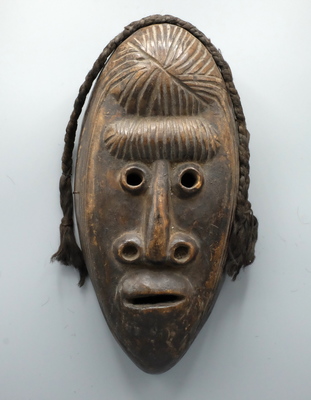
The mask is in overall excellent condition. There is some discoloration (or natural variation) in the wood, although this is likely the result of either usage or the facsimile of usage. The fibers of the hair pieces are delicate to the touch, and the hair is attached only by a point at the top and should be handled carefully. There are also nails on either side to secure the braids to the mask, but the braids have come free. On the back of the mask, the holes around the perimeter are all intact, indicating either that the mask has not been used with attached accessories or else that it has not been used roughly. Also on the back, just between the two eye holes and lower, where a person’s nose might rest, is a shiny patina that could be a sign of wear, but, in this case, has likely been created to give the impression of use. Also on the back is a loop of fishing wire tied between two of the holes, which is not original to the piece. Just under the fishing wire on the left side is a handwritten tag reading “#7 Ngere.” This is also not original and was almost certainly added at Von Barghahn Gallery. Ngere is an outdated term for Wé (or Guere).
References
Brad Hostetler, with Ani Parnagian, "From Private to Public: The Collection of David P. Harris," in Ethiopian Objects in the Blick-Harris Study Collection: Art, Context, and the Persistence of Form, eds. Brad Hostetler, and Lynn Jones, Peregrinations: Journal of Medieval Art & Architecture 8, no. 1 (Spring 2022): 5–25. https://digital.kenyon.edu/perejournal/vol8/iss1/1/.
Description
In both Wé (Guere) and Dan societies, masks are sometimes used for ritual practices and, more frequently, for entertainment. Since the 1950s, masks have also been produced on a large scale for the international tourist market. This wooden face mask, from Côte d'Ivoire or Liberia, is likely one such mask produced for the tourist market and features elements shared by many Wé and Dan masks, as well as some that are more typical of one or the other.
The long, oval face shape is common to masks made by both peoples; however, the smooth planes of the mask and relatively naturalistic depiction of the face are much more typically Dan, as are its unpainted surface and the inclusion of braided fibers representing hair (Brooklyn Museum no. 56.6.26, Met Museum no. 1978.412.303). In addition to the eyes, nose, and mouth, at the top of the mask, there are two raised sections covered in striated lines: a circular section with lines extending outward in four directions, and, just below it, a horizontal oval section. These lines may represent additional hair. Several longer scarification lines, continuing down from the shorter lines in the top section, follow the sides of the convex mask vertically, ending just below the mouth.
The eyes take the form of open, protruding circles, placed closely together on each side of the long, narrow nose bridge. This eye shape, though seen in some masks made by Dan people in Côte d'Ivoire, is usually considered more distinctly Wé (Brooklyn Museum no. 69.133.5), or is the result of a melding of styles and elements. The eye holes completely perforate the mask and are visible on the reverse. Almost exactly resembling the eye shape, large nostrils emerge from the bottom of the nose with the same jutting, tubular form, though, notably, the openings of these circles are purely decorative and do not go through the mask completely. This double feature, repeated in the nose and eyes, is the most striking element of this mask and is seldom seen in masks that are so formally simple (Met Museum no. 1982.487.2).
Evidence that the mask was probably produced for this tourist market and likely never used by local people includes the lack of decoration, such as paint or the attachment (or traces of former attachment) of other materials or objects; by the absence of a second set of openings from which the wearer would actually see; and from the relative lack of wear on the small holes around the edge of the mask, which would typically be used to attach the mask to the rest of the wearer’s attire (Met Museum no. 1978.412.527). However, on the back of the mask, there is some patina between the eye holes and where a person's nose might rest, a potential indication of wear. Yet, this patina is often intentionally added to masks by makers and sellers to give the appearance of use, which is likely the case in this circumstance, given that there are no other signs of usage.
Works Cited
Gnonsoa, Angèle. Le Masque au Cœur de la Société We. Malthouse Press editions, 2007.
Grootaers, Jan-Lodewijk, and Alexander Bortolot, eds. Visions from the Forest: The Art of Liberia and Sierra Leone. With contributions by Mariane Ferme, Barbara C. Johnson, Christine Kreamer, Nanina Guyer, Daniel Reed, and Jan-Lodewijk Grootaers. Minneapolis Institute of Arts, 2014. Distributed by University of Washington Press. Published in conjunction with an exhibition of the same title, organized by the Minneapolis Institute of Arts and first presented at the National Museum of African Art, April 9-August 17, 2014.
Steiner, Christopher Burghard. African Art in Transit. Cambridge University Press, 1994; entire book, but particularly 35, 140.
Visona, Monica B., Robin Poynor, and Herbert M. Cole. A History of Art in Africa. 1st ed. Pearson/Prentice Hall, 2001, 184-187.
Keywords
David P. Harris Collection, Mildred and Joseph von Barghahn, African, West African, After 1800, Masks