

Creator Biography
George Grosz, German, 1893–1959 (artist).
Malik-Verlag, German, active Berlin, 1916–1947 (publisher).
Preview
Creation Date
1928
Geography
Germany
Culture
German
Medium
Dimensions
7 1/16 × 10 9/16 × 9/16 in. (18 × 26.8 × 1.5 cm)
Credit Line
Purchase by the Department of Art History, 2025
Accession Number
2026.1
Description
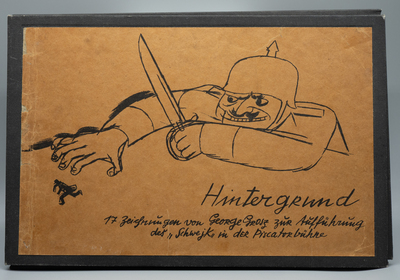
This portfolio of seventeen prints was published for the opening of the Good Soldier Schwejkat in November 1928. The play was adapted by Erwin Piscator from a novel by Czech writer Jaroslav Hašek and performed at Berlin's Theatre am Nollendorfplatz. The novel, play, and George Grosz's prints all present an anti-war satirization based on the events of World War I. Grosz had served for part of the war, but the remainder of it he spent in Berlin making violently anti-war drawings that led to his prosecution for insulting the army and blasphemy. Within this portfolio, his depiction of crucified Christ wearing a gas mask (2026.1.10) led to a charge of blasphemy.
Individual Digital Kenyon entries for the prints within this collection can be found at the following links
(2026.1.1–2026.1.17)
Schwejk: „melde gehorsamst, daß-ich blöd bin“ (Schwejk: “Beg to report, I’m an idiot”)
seid untertan der Obrigkeit (Bow to the Authorities)
Volkes Stimme (The Voice of the People)
Der Lebensbaum (The Tree of Life)
Das ganze Volk ist eine Simulantenbande (The Entire Population is a Bunch of Malingerers)
in drei Tagen sind sie felddienstfähig! (in Three Days You'll Be Fit for Field Duty!)
ein bischen gut zureden (Just a Little Persuasion)
die Ausschüttung des heiligen Geistes (The Outpouring of the Holy Spirit)
Maul halten und weiter dienen (Shut Up and Do Your Duty)
Bitte recht freundlich (Please look friendly)
Mir ist der Krieg wie eine Badekur bekommen (The War Did Me a Lot of Good, Like a Spa)
Mit Herz und Hand für’s Vaterland (With Heart and Hand for the Fatherland)
Bald wieder: „je grausamer, je humaner.“ (Soon Again: "the More Cruel, the More Human")
Keywords
Department of Art History Collection, European, German, After 1800, Expressionism, Dada, World War I