

Preview
Creation Date
400–401 CE
Geography
Nicomedia (İzmit, Turkey)
Culture
Roman, Byzantine
Medium
Copper
Dimensions
18.5 mm in diameter, 1 mm thick
0.088 oz. (2.5 g)
Credit Line
Gift of Brad Hostetler, 2022
Accession Number
2022.44
Provenance
Purchased by Brad Hostetler from Richard Morin (Palm Coast, Fla.) on July 18, 2022.
Condition
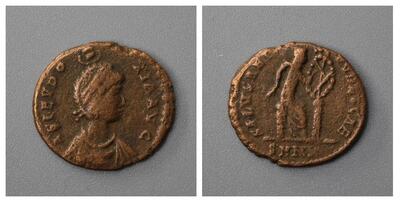
The condition of the coin is good; it is largely undamaged. There is a fair amount of tarnishing especially in the areas of lower relief and about half the inscription has been worn away. On the obverse, there is some loss near the top right side of the coin, between the 12 and 1 o’clock positions; there is some even smaller loss at 5 o’clock. The left edge of the coin is smooth and the right edge of the coin is more jagged. - Maren Stossel (’26), December 2022
Signatures, Inscriptions, and Markings
Obverse:
AELEVDO XIAAVC
Aelia Eudoxia Augusta
Reverse:
SALVSREI PVBLICAE
Welfare of the Republic
SMNA
References
Grierson, Philip, and Melinda Mays. 1992. Catalogue of Late Roman Coins in the Dumbarton Oaks Collection and in the Whittemore Collection: From Arcadius and Honorius to the Accession of Anastasius. Washington, DC: Dumbarton Oaks Research Library and Collection, no. 279, p. 376.
Description
This early fifth century Late Roman coin of Aelia Eudoxia is typical of coins with similar denominations from that period. The obverse of the coin features the head of Eudoxia in profile. There is a Manus Dei, symbolic of the hand of God, delivering a crown above her head (Grierson and Mays 1992, p. 76). The reverse of the coin features the seated figure of Victory who is inscribing a Chi-Rho symbol on a shield. This iconography was consistent with coins of other empresses from the same period, including those of Eudoxia’s mother-in-law, Aelia Flaccilla. The Chi-Rho shield originated from Constantine taking the first two Greek letters of Christ’s name, Chi (X) and Rho (P), and putting them on his shields and standards. The inscriptions on the reverse read “SMNA”, referring to the mint location; and “SALVSREI PVBLICAE” meaning the well-being or health of the empire (Brubaker and Tobler 2000, p. 579).
The coin was minted between 400 and 401 CE in Nicomedia workshop “A”. It is a copper Æ3, which is worth about 1/960th of a gold solidus, the most valuable currency, and would likely have been owned by someone of lower status as copper coins were more commonly circulated among the non-rich (Mattingly 1946, pp. 117–118).
Coins of Eudoxia started being minted in the year 400 CE after she was made Augusta, a title given to specific and a few imperial women. Eudoxia held power over her husband and was a shrewd politician, using, or abusing according to some, her power to famously depose St. John Crysostom, the Patriarch of Constantinople at the time (Holum 1982, pp. 48–78). This is consistent with the iconography of her coins. She inherited the profile pose and iconography of Victory from the previous empress, her mother-in-law, and she appropriated the iconography of the Manus Dei that her husband introduced in his first coinage, and continued to use throughout his reign. Both leaders are shown in the same profile pose with similar crowns. It can be suggested that Eudoxia appropriated this iconography in order to to resemble her husband, and to claim some of that power through her imagery.
Bibliography
Brubaker, Leslie, and Helen Tobler. 2000. “The Gender of Money: Byzantine Empresses on Coins (324–802).” Gender & History 12: 572–594.
Grierson, Philip, and Melinda Mays, 1992. Catalogue of Late Roman Coins in the Dumbarton Oaks Collection and in the Whittemore Collection: From Arcadius and Honorius to the Accession of Anastasius. Washington, DC: Dumbarton Oaks Research Library and Collection.
Holum, Kenneth G. 1982. Theodosian Empresses: Women and Imperial Dominion in Late Antiquity. Berkeley: University of California Press.
Mattingly, Harold. 1946. “The Monetary Systems of the Roman Empire from Diocletian to Theodosius I.” The Numismatic Chronicle and Journal of the Royal Numismatic Society 6, no. 3/4: 111–120.
Maren Stossel (’26) for ARHS 110 (Fall 2022)